
A coordinate time assigned by synchronized clocks differs from the proper time of a moving clock. An emergent-time theory must reproduce their relation through material readouts, not a relabeling of its update index.
Einstein’s operational starting point
Einstein’s 1905 paper On the Electrodynamics of Moving Bodies begins its kinematic analysis by asking how distant clocks are compared. It uses light signals to define synchronization in a frame and develops the consequences of the relativity principle and light-speed postulate.
The historical change is not that people suddenly noticed clocks can be inaccurate. It concerns the relations assigned to ideal measurements themselves. Statements about distant simultaneity require a procedure, and transformations between moving frames act on both spatial and temporal readings. This operational focus provides a demanding benchmark for any proposal that claims to derive observed time from a deeper process.
Work a light-signal comparison
Send a signal from A at reading t₁, reflect it at B, and receive it back at A at t₂. In the standard inertial-frame synchronization convention, B’s reflection is assigned the midpoint reading (t₁+t₂)/2. With readings two and eight, the midpoint is five.
The round-trip interval is directly compared on A’s clock; assigning equal outward and return travel times is part of the synchronization construction. The physical theory relates this convention to its inertial-frame light law and other measurements. A model should keep the locally recorded events, the synchronization convention, and the transformation between frames explicitly distinguished.
Why a shared timestamp is frame dependent
In one spatial direction, a Lorentz transformation gives Δt′=γ(Δt−vΔx/c²). If two separated events have Δt=0 in one inertial frame, then Δt′=−γvΔx/c² in another moving frame. Their equal time label is therefore not preserved in general.
This concerns separated events. If two processes meet at the same event, every coordinate description represents that coincidence. The distinction matters for a generative theory: a hidden formation order cannot be identified directly with a universal public simultaneity unless the model explains how its observable predictions remain compatible with relativistic event comparisons.
Calculate a path’s elapsed duration
For a constant-speed timelike segment in flat spacetime, Δτ=Δt sqrt(1−v²/c²). At v=0.6c, the factor is 0.8, so ten units of coordinate duration correspond to eight units on the moving ideal clock.
For several segments, the proper durations add along the clock’s path. Different paths between suitable shared endpoints can accumulate different totals. The result is a geometrical clock relation, not a statement that a traveler subjectively feels every process slowing. A physical model must explain why its actual clock approximates the ideal proper-time behavior in the intended regime.
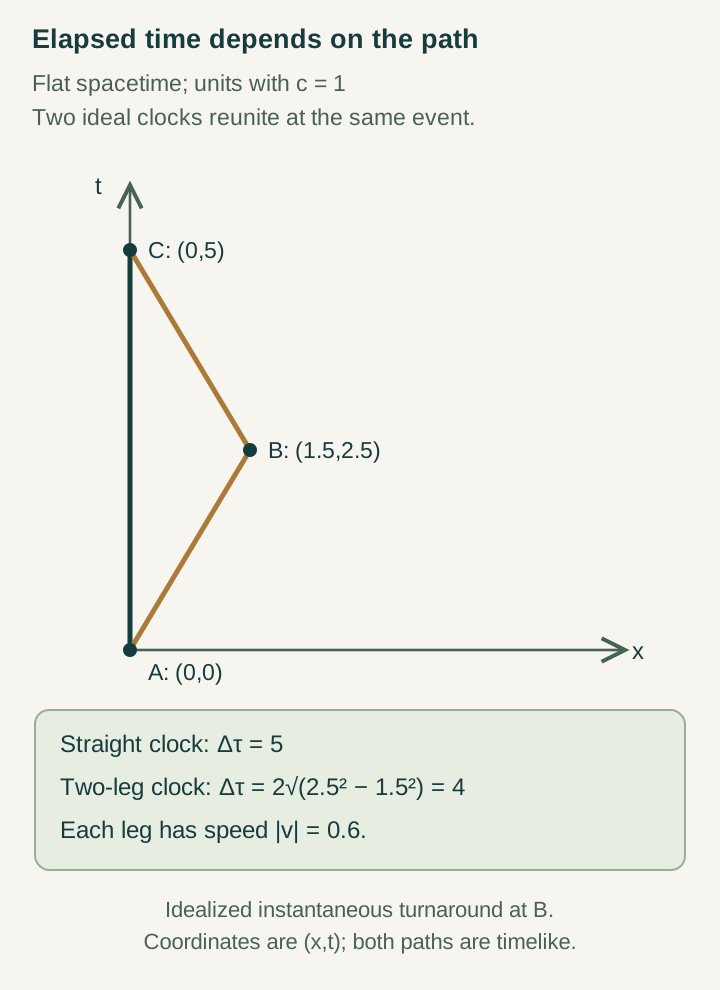
Open the full-size diagram →
As a check, setting v=0 returns ten units for both clocks. For a changing subluminal speed, apply the same factor over short intervals and add their contributions. This is an ideal-clock calculation; constructing a material clock that realizes it is a separate physical question.
A speed bound is only one ingredient
A finite update that moves a signal at most one link per completion supplies a propagation bound after link length and completion duration are calibrated. A lattice can nevertheless retain preferred directions or clock responses that fail to match Lorentz kinematics.
SMM/DTT therefore needs a joint construction of distance, clocks, and matter propagation. Split-complex algebra can represent hyperbolic transformations through j²=+1, but algebraic preservation of a quadratic form does not establish that physical detectors measure its variables. The connection has to be derived from the source dynamics and the allowed completed observations.
The constructive historical lesson
Read A9, A15, A17, and A65, then follow A129–A133 and A166–A170. Einstein’s primary text is valuable because its definitions expose the operations behind familiar formulas. A reconstruction should be at least as clear about the instruments and comparisons it claims to explain.
The next DTT question is whether a single nested source can make independently prepared material clocks and propagation modes share one operational cone. Which source distinctions remain unobservable under every admitted experiment, and which would produce a measurable preferred ordering? Resolving that question would connect inner generation to relativity through actual consequences rather than simply calling one of the two times proper time.
Continue with the articles
- Time in Modern Science
An introduction to the operational roles of time in modern science, distinguishing clock readings, dynamical parameters, and irreversible processes before connecting them with the generative and observed roles of time in DTT.
- Space-Time and the Speed of Light
Introduce the relationship between spatial extension, temporal order, and the limiting speed. Use it as a bridge between the original cosmological discussion and later DTT reconstruction work.
- Relative and Curved Time
An introductory discussion of relative time and the geometric language of curvature. Prepare a careful comparison between historical temporal imagery and modern spacetime descriptions.
- Simultaneity
Introduce simultaneity as a relation between events rather than a self-explanatory universal fact. Connect the concept to clock conventions and the role of completed records.
- A finite-update cone
Introduce the bound relating horizontal displacement to temporal projection in the limiting-speed draft. Explain that the finite-update inequality is a stated geometric assumption.
- Why light must share the same cone
Examine the additional assumption that electromagnetic dynamics inherit the constructed null geometry. A limiting cone in one sector does not automatically establish universal propagation across all fields.
- One clock direction plus three readout directions
Explain the rank-one clock and rank-three readout used in the conditional four-dimensional construction. Clarify why a soldering map is needed to identify them with tangent directions.
- When geometric symmetries become physical boosts
Compare automorphisms of a mathematical geometry with transformations realized by physical observers. Explain why frame richness is an additional requirement for identifying the two.
- What Lorentzian reconstruction leaves open
Summarize the boundary of the constraint-relative theorem. Recovering a causal geometry does not itself determine matter dynamics, the numerical limiting speed, or Einstein’s field equations.