A recurring source process, an ordinary oscillator and a time crystal are not interchangeable. Time-crystal research supplies precise criteria for temporal order and robustness. Comparing an elementary period-doubled system with DTT’s inner cycles shows how recurring behavior can become a measurable physical claim without being mistaken for the creation of time itself.
A pendulum oscillates, an internal phase returns and a periodically driven system may repeat. None of these observations alone establishes a time crystal. The relevant question is how a system’s temporal order relates to the symmetry of its dynamical law and how that order responds to perturbations.
DTT’s cyclical inner generation addresses the production and completion of observable configurations. It need not postulate that an equilibrium material body visibly oscillates forever. A comparison with time crystals is useful when it asks which source correlations or completion patterns are observable, stable and distinguishable from an ordinary driven response. [1]
02Equilibrium and driven settings
Watanabe and Oshikawa proved a no-go result for equilibrium time-crystalline order under their specified Hamiltonian and interaction assumptions. Driven Floquet systems constitute a different setting. Else, Bauer and Nayak formulated discrete time-translation symmetry breaking and studied its realization in driven many-body systems.
The important distinction is the physical regime. A driven system already has a drive period T. A robust response with a larger period can break the drive’s discrete time-translation symmetry. This does not supply a universal cosmic clock, and the equilibrium no-go theorem does not by itself forbid every kind of nonequilibrium temporal ordering. [2][3]
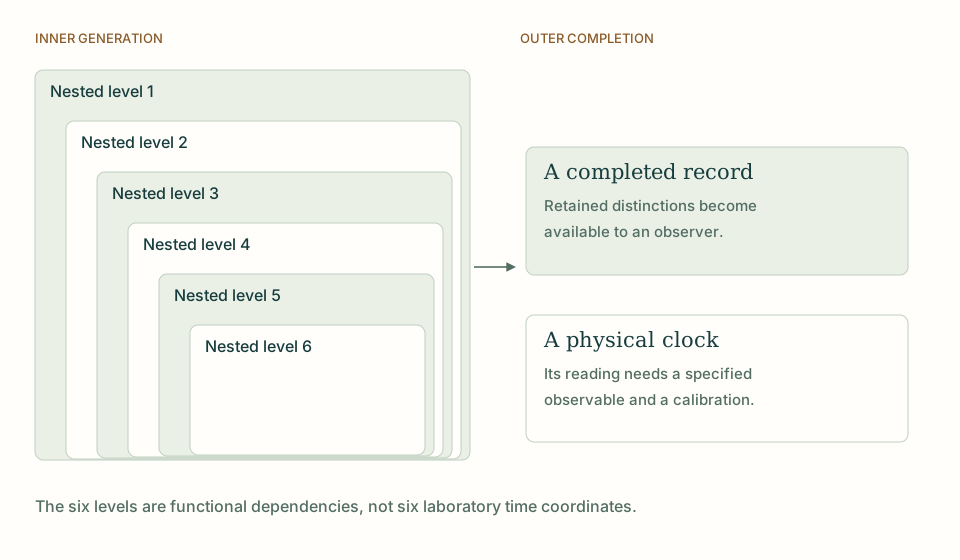
Six nested inner levels and outer completion. The nesting indicates functional dependence in the SMM/DTT proposal. Outer completion makes a retained result available; it does not turn the six levels into six independently measured clocks. View full size ↗
03A transparent period-doubling example
Consider an idealized single spin with one-period unitary U(T) = σx and initial state |0⟩. After one period it is |1⟩ and after two periods it returns to |0⟩. The measured z polarization alternates as (−1)ⁿ on the stroboscopic sequence nT. Its response period is 2T.
This calculation demonstrates period doubling, but not a stable many-body time-crystal phase. If the spin rotation is slightly miscalibrated, an isolated spin can drift away from exact alternating order. The physically interesting question is whether interactions and an appropriate dynamical regime protect the subharmonic response against allowed perturbations.
U(T) = σx, U(T)² = I
⟨σz(nT)⟩ = (−1)ⁿ
Response period = 2T
An ideal single-spin illustration of period doubling; robustness and a many-body phase are additional questions.
04A corresponding question for inner cycles
Suppose a source has six nested inner roles and completes an outer record after its internal operations close. An external reader might observe one output for every full completion, while internal variables recur more frequently. This does not select a time-crystalline phase unless the observable correlations and symmetry-breaking criterion are defined.
The useful translation is to ask whether a completion pattern is robust. If a slight change in an internal coupling destroys the claimed six-level schedule, it may be a chosen controller program. If a source constraint protects the observable pattern across a range of perturbations, the recurrence has stronger dynamical content. The protection mechanism, rather than recurrence alone, is the point of contact. [1]
05A correlation rather than a metaphor
For a specified observable O, one can examine correlations sampled after n completion periods. Persistent oscillatory structure must be distinguished from finite-size transients, an externally imposed clock signal, and a receiver’s chosen sampling rule. These distinctions prevent a plotted repeating curve from carrying more meaning than its dynamics supports.
A source model could calculate its correlation function, include memory and finite-resource limits, and compare perturbed parameter values. Such a result would connect generative cycles to physical temporal order. It would still describe a particular model, not establish that all of cosmic reality is a time crystal or that experimental time crystals verify SMM/DTT.
06A period-doubled record and the need for stability
For the ideal single-spin pulse example, a receiver that measures the same spin component after each pulse can record an alternating sequence. A small pulse-angle error generally changes that sequence over repeated cycles. This explains why exact alternation in one perfectly tuned toy system is weaker than a stable collective response under a stated class of perturbations. The ideal pulse already contains the chosen period and rotation angle as inputs.
An SMM/DTT model can nevertheless use such a receiver as a concrete beginning. It specifies an inner operation, an outer sampling rule and a retained sequence. The stronger research target is then to explain how the source stabilizes the relevant operation and why the sampling rule is physically available. Comparing ideal alternation with its perturbed version prevents a periodic drawing from carrying the explanatory burden of a dynamical phase, while preserving a clear role for temporal renewal in the construction of repeatable material records.
07The productive conclusion
The comparison adds a criterion that is useful beyond the specific time-crystal literature: an observed temporal pattern should be defined by an observable and protected by a mechanism. DTT’s nested generation can then be assessed through stable completion statistics, instead of relying only on a visual analogy with cycles.
This also protects the broader philosophical idea of renewal from an unnecessary identification with one condensed-matter phase. A common generative source and a driven many-body system address different explanatory levels. Their strongest connection is a transferable mathematical question about temporal symmetry, recurrence and robust observable order.
THE SAME QUESTION, DIFFERENT STARTING POINTS
The comparison at a glance
Question
SMM/DTT
Floquet time crystals
Recurrence
Inner operations may cycle before outer completion.
Ordinary oscillation alone does not define a time crystal.
Robustness
A source law should protect the relevant completion structure.
A time-crystalline claim concerns stable temporal order in a specified regime.
Interpretation
Temporal renewal concerns the generation of observable configurations.
Floquet systems exhibit temporal behavior relative to a supplied drive period.
KEEP THE CONNECTION
Key ideas
An alternating single spin illustrates period doubling but not a robust many-body phase.
Equilibrium no-go results and driven time crystals concern different assumptions.
SMM/DTT can borrow the requirement of dynamical protection without claiming experimental confirmation from time crystals.
References support the comparator and the specific mathematical or interpretive claims indicated. SMM/DTT connections are developed in the analysis above.