Temporal holography and the covariant entropy bound
A finite number of inner records suggests a capacity bound, while gravitational holography relates entropy to area. The two ideas become comparable only after the records, region and entropy are defined. A worked 137-state example shows how a temporal information model could meet an area bound without deriving that bound from counting alone.
A source with a restricted record space can carry only a restricted set of perfectly distinguishable messages in one use. A gravitational entropy bound concerns which entropy can be associated with a specified geometric construction. Both restrict information, but the objects they constrain are different.
SMM/DTT’s temporal-holography idea asks whether observable information can be understood through the source’s inner states and their completed records. To connect that proposal with gravitational holography, the source must also supply the geometric screen or causal region and the physical entropy associated with its records. The word holography alone does not provide that map. [1]
02The covariant benchmark
Bousso’s covariant entropy conjecture uses a two-dimensional surface and an associated light-sheet generated by null geodesics with nonpositive expansion. In the appropriate units and domain, the entropy on the light-sheet is bounded by a quarter of the initial area in gravitational units. It is a geometric statement with causal restrictions, not an unrestricted rule assigning A/4 to every arbitrary subsystem.
The original formulation and subsequent work concern a precise relation among entropy, null geometry and gravity. For the present comparison, its role is to provide a target with an explicit surface and causal domain. A temporal source construction would need to generate those ingredients before identifying an inner-state count with the bounded entropy. [2]
S/kB ≤ A/(4ℓP²), ℓP² = ℏG/c³
The covariant statement applies to the relevant light-sheet and physical assumptions, not to an arbitrary abstract list of states.
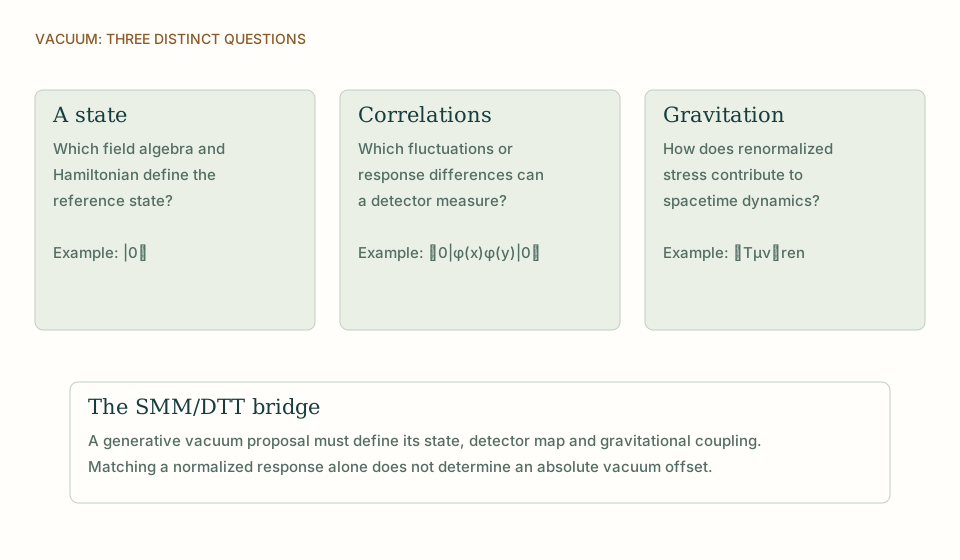
Three distinct questions about the vacuum. A quantum state, its measurable correlations, and its gravitational stress are different objects. A proposed generative source needs an explicit map to each. View full size ↗
03The entropy of a finite record register
For a register with D distinguishable states, the maximum von Neumann entropy is kB log D, attained by the maximally mixed state. A pure state in the same space has zero entropy. The carrier’s dimension therefore fixes a maximum capacity, not the actual entropy of every preparation.
For D = 137, the maximum entropy is approximately 4.920kB, or about 7.098 bits. These numbers follow from a specified finite receiver. They do not say that a physical region of the universe has 137 states, and they do not assign the fine-structure constant to an entropy. The example is a controlled way of translating a structural count into a possible information quantity.
The logarithm in entropy is natural; log₂D gives the corresponding ideal classical message capacity.
04A conditional area inequality
If the maximally mixed 137-state register represented the entropy of an allowed light-sheet and the bound applied, combining the two expressions would require A ≥ 4ℓP² log 137, approximately 19.68ℓP². This conclusion is conditional on a physical identification of the register with that light-sheet entropy.
Reversing the argument and declaring that any 137-state mathematical space must occupy that area would be invalid. The finite receiver has no area until a geometric model supplies one, and it need not be maximally mixed. The conditional calculation is useful because it identifies exactly which physical bridge is needed between temporal records and an area law.
If S = kB log 137 and the bound applies:
A ≥ 4ℓP² log 137 ≈ 19.68ℓP²
05Area growth versus history growth
A branching record grammar may increase the number of histories exponentially with depth. A geometric area may scale differently with refinement. A genuine temporal-holography model must show why physically accessible histories obey the relevant area scaling, perhaps through constraints, limited distinguishability or relations among inner degrees of freedom.
This is a promising explanatory task for a common-source theory. It asks why a receiver cannot independently access every microscopic distinction suggested by naive local counting. The answer must be dynamical or operational: simply deleting states until a desired entropy bound holds would encode the result rather than derive it. [3]
The number 137 can enter an entropy calculation only after one states how those alternatives are populated. For probabilities p₁ through p₁₃₇, the classical record entropy is −kB times the sum of pᵢ ln pᵢ. It reaches kB ln 137 for a uniform distribution and is zero for a single certain label. The same available alphabet therefore supports different actual record entropies.
This distinction is useful when comparing a structural source receiver with gravitational entropy. A capacity bound refers to the possible distinctions the receiver can carry, while a state entropy refers to a preparation. Applying a geometric entropy bound also requires a justified assignment of the records to its light-sheet or other stated domain. A successful SMM/DTT construction would connect these three ingredients—admissible records, their state and their geometric localization—rather than infer a universal area directly from the alphabet size.
07What a useful new result would look like
A finite source model could define a causal boundary, enumerate its accessible records, calculate their entropy and derive a bound in terms of a separately reconstructed area. The comparison should include nonmaximally mixed states and changes in allowed observations, because entropy depends on both preparation and access.
If a robust area relation emerged across a family of source states with fixed rules, the temporal proposal would gain a concrete gravitational connection. Until then, finite capacity and covariant holography remain related but separate results. Keeping their bridge explicit allows the SMM/DTT information programme to advance through calculable steps.
THE SAME QUESTION, DIFFERENT STARTING POINTS
The comparison at a glance
Question
SMM/DTT
Covariant entropy bounds
Count
Inner histories can define a finite receiver under a chosen grammar.
Dimension D bounds the maximum entropy by kB log D.
Screen
The source should generate the region and its causal boundary.
A covariant bound uses a specified surface and light-sheet.
Physical bridge
Relate accessible temporal records to a reconstructed area law.
An abstract state count has no automatic spatial area.
KEEP THE CONNECTION
Key ideas
A D-state register has maximum entropy kB log D, but need not attain it.
The covariant bound is tied to a geometric light-sheet and its conditions.
Temporal holography becomes physical when a source model derives the record-to-area relation.
Connect records with reconstructed metric geometry.
Sources and further reading
References support the comparator and the specific mathematical or interpretive claims indicated. SMM/DTT connections are developed in the analysis above.