C406Connections across theories
A field theory can be organized by the observable algebras available in spacetime regions. This comparison works through local commuting algebras with a globally entangled state, explains the extra requirements for a continuum field theory, and asks how DTT can generate both the regions and their causal measurement structure.
Comparative article · 5 min read↗
C409Connections across theories
The no-boundary proposal specifies a cosmological quantum state through a regular geometric construction. This article works through the Euclidean de Sitter cap and its Lorentzian continuation, distinguishes an analytic calculation from physical time conversion, and compares that state-selection problem with SMM/DTT’s deeper source-origin question.
Comparative article · 5 min read↗
C427New research questions
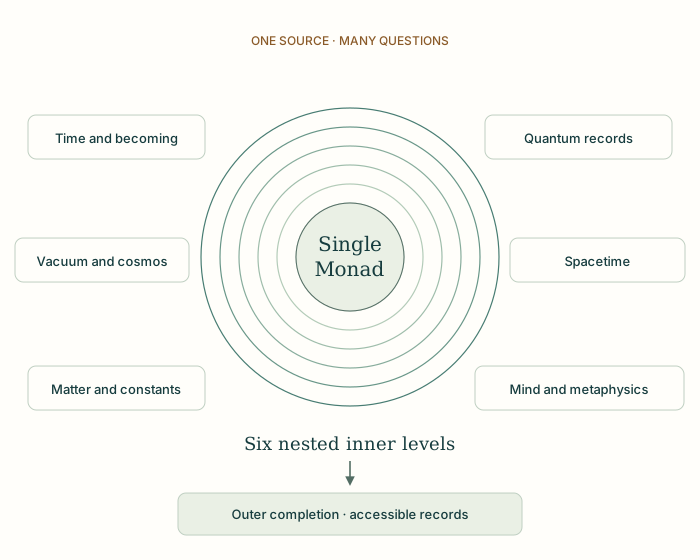
Quantum Darwinism studies how selected information spreads into many environmental records that different observers can read. This guide calculates an exact redundancy example, distinguishes shared classical information from copied quantum states, and develops a concrete comparison with DTT’s outer completion and its single-source account of an accessible world.
Research guide · 5 min read↗
C428New research questions
Quantum error correction preserves an unknown state by encoding it in correlations and learning only the error syndrome. This guide works through a three-qubit code, calculates its logical failure rate, and asks how DTT’s nested source architecture could protect coherent inner memory while publishing stable outer records.
Research guide · 6 min read↗
C429New research questions
Correlations alone can leave a common cause and a direct influence observationally indistinguishable. This guide demonstrates the difference with an intervention, explains the quantum role of instruments and memory, and develops an operational route for asking whether DTT’s single-source architecture imposes a distinctive causal structure.
Research guide · 5 min read↗
C430New research questions
Two local probes can become entangled by coupling to correlations already present in a quantum field vacuum. This guide explains the detector mechanism and its noise threshold, distinguishes harvesting from signalling or free-energy extraction, and identifies the correlation functions a DTT generative vacuum would need to predict.
Research guide · 5 min read↗
C431New research questions
The published DESI DR2 analysis offers a concrete test of evolving-dark-energy models, with significance that depends on the data combination. Reviewed on 17 October 2026, this guide explains that named 2025 result, works through the usual equation-of-state parameterization, and identifies what a DTT source law must predict before comparison.
Research guide · 5 min read↗
C432New research questions
Gravity-mediated entanglement proposals ask whether two masses can acquire a quantum correlation through their interaction. This guide derives the relevant two-body phase invariant, explains the assumptions behind a mediator witness, and identifies the source Hamiltonian and record dynamics DTT would need to make a concrete prediction.
Research guide · 5 min read↗