The no-boundary proposal specifies a cosmological quantum state through a regular geometric construction. This article works through the Euclidean de Sitter cap and its Lorentzian continuation, distinguishes an analytic calculation from physical time conversion, and compares that state-selection problem with SMM/DTT’s deeper source-origin question.
01A state prescription and an ontology answer different questions
Hartle and Hawking proposed a wavefunction of the universe defined through a path-integral prescription over suitable regular geometries and matter configurations with a specified boundary. The proposal aims to select a cosmological quantum state. Its measure, contours, approximation schemes and physical predictions require careful treatment; it is not a demonstrated mechanism of creation from metaphysical nothing.
SMM/DTT begins with a nonspatial source and seeks to generate the observable arena itself. That is a different ontological starting point, though the programmes can meet when a source construction yields an effective cosmological state. The comparison becomes productive when it asks which state and geometry follow from the source, rather than equates a regular geometric pole with the Single Monad. [2]
02The source and its two temporal roles
The Single Monad Model begins with one nonspatial generative source. The Duality of Time Theory distinguishes the source’s inner production from the outer order in which completed records become accessible. Its six inner levels are nested functional roles of one process: a higher role organizes lower-level work. The seventh is the completion or observation interface. They are neither six independent clocks nor six additional time coordinates.
This distinction supplies a useful research question: which features of an observed world can follow from the way a source produces, retains and releases information? A concrete answer needs a state space, an autonomous update, retained memory and a rule connecting completion to an accessible measurement. In the constructions discussed here, those mathematical ingredients are stated explicitly. A successful finite example establishes what its specified mechanism can do; further arguments connect it to physical particles, spacetime or universal laws. [1]
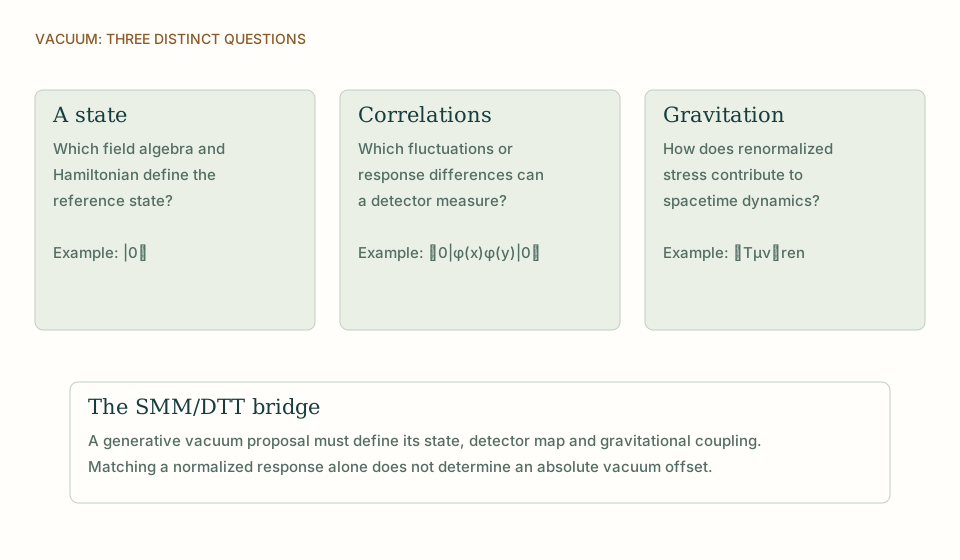
Three distinct questions about the vacuum. A quantum state, its measurable correlations, and its gravitational stress are different objects. A proposed generative source needs an explicit map to each. View full size ↗
03Worked regular cap and continuation
In units c=1, consider the Euclidean de Sitter metric ds²=dτ²+a(τ)²dΩ₃² with a(τ)=H⁻¹sin(Hτ). Near τ=0, a(τ)≈τ, so the shrinking three-sphere closes smoothly in the regular four-dimensional geometry. The coordinate endpoint is not a curvature singularity of that cap.
Continue around the equator by τ=π/(2H)+it. Then sin(Hτ)=cosh(Ht) and dτ²=−dt², producing the Lorentzian closed de Sitter scale factor a(t)=H⁻¹cosh(Ht). This calculation explains a mathematical relation between saddle geometries. It does not show a physical observer travelling along imaginary time or prove that a source converts one physical clock into another. [2][3]
aE(τ)=H⁻¹sin(Hτ); τ=π/(2H)+it ⇒ aL(t)=H⁻¹cosh(Ht)
Illustrative de Sitter saddle with c=1. The analytic continuation is part of the mathematical construction, not an independently observed evolution process.
04A regular point is still geometric structure
The Euclidean cap presupposes a metric, dimension, field content and a gravitational action. Its smooth pole is a point of that geometry, even though a family of spatial sections shrinks there. The Single Monad, as a proposed nonspatial source, is not automatically that point. Identifying them would silently import the surrounding geometry that SMM is supposed to explain.
A better connection is conditional: a source law might produce an effective amplitude for geometries, and in a suitable approximation that amplitude might select regular no-boundary-like saddles. Such a result would state what has been derived and what remains inherited from the effective gravitational theory. It would also keep the six nested inner roles distinct from coordinates on a Euclidean manifold. [2][1]
05Initial-state selection remains consequential
Different cosmological states can lead to different perturbation correlations and probabilities for background histories. A DTT source that selects one state would therefore add more than a philosophical interpretation, provided its selection rule is fixed independently of the observations it is meant to explain. The resulting perturbations still need to be propagated through a physical cosmological model.
The no-boundary comparison is useful precisely because it presents a concrete state-selection problem. A source model cannot replace it with the statement that the world is re-created at every instant. It needs an amplitude or probability rule, an action or update law and a map to the effective geometry. Normalization and the meaning of conditional observations in a closed universe are part of that task. [2][4]
06The strongest possible synthesis
A substantive result would derive a restricted cosmological state from one autonomous source and show a controlled correspondence with a regular gravitational saddle. The same construction would identify the physical clocks and matter records that appear in its Lorentzian regime. That would connect the source ontology with a calculable quantum-cosmology proposal.
Until such a bridge is established, the regular-cap example is an instructive comparison, not evidence that analytic continuation verifies dual physical times. DTT can retain its distinctive claim of generative priority while using the no-boundary proposal as a benchmark for mathematical precision: an explicit state, clear assumptions and consequences for accessible cosmological observables. [2][3]
THE SAME QUESTION, DIFFERENT STARTING POINTS
The comparison at a glance
Question
SMM/DTT
Hartle–Hawking no-boundary proposal
Origin
The Single Monad is a proposed nonspatial source, not simply a geometric pole.
The no-boundary prescription begins with a gravitational configuration space and action.
Time roles
DTT must give operational meaning to any physical distinction between temporal roles.
Euclidean-to-Lorentzian continuation is an analytic construction.
Predictive bridge
A source law could select an effective cosmological state and its perturbations.
The proposal supplies a particular state-selection programme with technical assumptions.
KEEP THE CONNECTION
Key ideas
The Single Monad is a proposed nonspatial source, not simply a geometric pole.
DTT must give operational meaning to any physical distinction between temporal roles.
The source interpretation becomes additional physics when it constrains an independently measurable process.
Connects the comparison to the programme’s current statement of results and assumptions.
Sources and further reading
References support the comparator and the specific mathematical or interpretive claims indicated. SMM/DTT connections are developed in the analysis above.