
In this article
- The question behind this comparison
- The SMM/DTT starting point
- How the comparator works
- The decisive comparison
- Worked benchmark
- What follows for the source programme


Ordinary quantum phase and hyperbolic time transformations preserve different mathematical structures. Comparing DTT with Everett many-worlds interpretation, this article works through real rotation and boost generators, explains how real dynamics can select a complex structure, and identifies the further steps connecting that result to observable quantum physics.
Quantum phase is a relation among amplitudes that becomes observable when alternatives recombine. An overall phase multiplies all amplitudes equally and does not change ordinary measurement probabilities; a relative phase can change them sharply. The relevant scalar unit in standard quantum mechanics obeys i²=−1. A split-complex unit j with j²=+1 describes a different algebra and cannot simply replace i while preserving the usual positive probability rule.
The DTT programme can connect temporal organization to phase by asking whether real source dynamics selects a compatible complex structure. Such a selection is a mathematical statement about an operator and the symmetries that commute with it. It is more specific than calling one temporal role imaginary. Establishing a complex structure does not yet establish the Hamiltonian, the Born rule or the physical meaning of its phase scale. [3] [4]
The Single Monad Model begins with one nonspatial generative source. The Duality of Time Theory distinguishes the source’s inner production from the outer order in which completed records become accessible. Its six inner levels are nested functional roles of one process: a higher role organizes lower-level work. The seventh is the completion or observation interface. They are neither six independent clocks nor six additional time coordinates.
This distinction supplies a useful research question: which features of an observed world can follow from the way a source produces, retains and releases information? A concrete answer needs a state space, an autonomous update, retained memory and a rule connecting completion to an accessible measurement. In the constructions discussed here, those mathematical ingredients are stated explicitly. A successful finite example establishes what its specified mechanism can do; further arguments connect it to physical particles, spacetime or universal laws. [1]
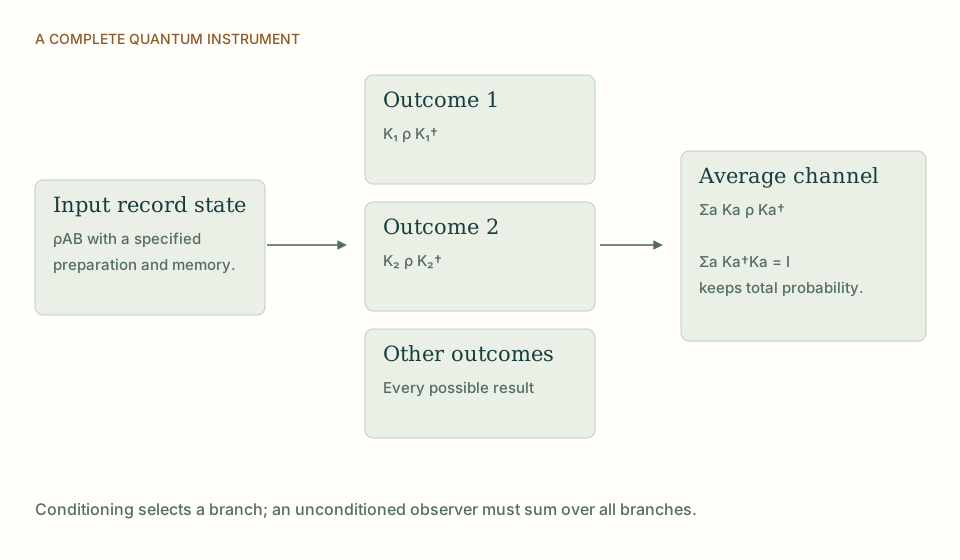
Everett’s relative-state formulation applies unitary quantum evolution to the apparatus and observer as well as to the measured system. Correlated components of their joint state encode different relative outcomes. Modern decoherence-based accounts use effectively stable environmental records to explain why these components behave as autonomous branches for practical observation. Their language of worlds is an interpretation of this branching structure, not an additional term in the Schrödinger equation.
Its main contrast with a completion account is the status of the alternatives. Everett keeps all components in the universal state; a DTT model must specify whether completion releases a relative record, selects one outcome by an additional rule, or discards information through an explicitly open channel. Each option has a different relationship to unitarity. Mere sequential generation of a superposition does not make it Everettian, and describing observed definiteness does not by itself disprove relative-state quantum mechanics. Both accounts still need justified probability assignments for repeated records. [2]
Everett relies on ordinary complex unitary evolution to maintain phases between components of the universal state. Relative branches become effectively autonomous when those phases cease to be locally accessible through decoherence, not when complex structure changes into a second time axis. DTT’s inner source could account for the origin or protection of this phase structure, while outer completion describes access to a relative record.
The genuine difference would be a restriction on which coherent superpositions the source can generate or preserve. If a selected complex structure commutes with the full evolution, it supports Everett’s mathematical framework rather than contradicting it. If completion destroys the corresponding phase information fundamentally, the model departs from universal unitarity and needs a quantitative law for that departure. Neither outcome follows simply from pairing real and imaginary temporal labels. The rotation-versus-boost calculation gives a clean diagnostic: a positive quantum norm is preserved by the former, while the latter preserves an indefinite form. Their coexistence must be explained by distinct roles within the mechanism, not described as interchangeable interpretations of one complex coordinate. [2] [3] [4]
On a real two-dimensional space take J=[[0,−1],[1,0]]. Direct multiplication gives J²=−I. The exponential of θJ is cosθ I+sinθ J, a rotation that preserves x²+y². Identifying (x,y) with z=x+iy converts that same real evolution into z↦e^{iθ}z. No second physical time coordinate was introduced.
By contrast, K=[[0,1],[1,0]] obeys K²=I. Its exponential is coshη I+sinhη K and preserves x²−y². This hyperbolic transformation is appropriate for an indefinite quadratic form, not the Euclidean norm that supplies an ordinary one-component Born probability. A temporal reconstruction may use both structures in different roles, but it needs a map explaining how they coexist. Substituting η=iθ is an analytic continuation of formulas; it is not a demonstration that a physical process rotates one type of time into the other. [3] [4]
θ and η are dimensionless. The two matrices preserve different bilinear forms and have different spectral properties.
This comparison turns a suggestive dual-time vocabulary into a testable algebraic question: what physical constraints select J, and which transformations preserve that selection? If several inequivalent complex structures remain allowed, further dynamics or boundary conditions are needed. A rank-three quaternionic readout can organize rotations and phase actions, but its algebraic rank must not be mistaken for a proof of an emergent three-dimensional metric manifold. [3] [4]
THE SAME QUESTION, DIFFERENT STARTING POINTS
| Question | SMM/DTT | Everett many-worlds interpretation |
|---|---|---|
| Starting structure | One nonspatial source, retained memory and six nested inner functions with an outer completion interface. | A universal quantum state with unitary evolution. |
| Observable connection | The source update and readout must generate the measured records and their calibrated relations. | A stable record is relative to a correlated branch. |
| Quantum phase and complex structure | The genuine difference would be a restriction on which coherent superpositions the source can generate or preserve. | Everett relies on ordinary complex unitary evolution to maintain phases between components of the universal state. |
| Status of the claim | A constructive research programme; a specified finite model establishes only its stated conditional results. | Relative-state interpretation retains ordinary unitary quantum predictions. |
KEEP THE CONNECTION
Connects this comparison with the author’s underlying construction.
Connects this comparison with the author’s underlying construction.
Connects this comparison with the author’s underlying construction.
Connects this comparison with the author’s underlying construction.
Places the comparison alongside the programme’s published results, assumptions and open targets.
References support the comparator and the specific mathematical or interpretive claims indicated. SMM/DTT connections are developed in the analysis above.
How these comparisons distinguish premises, results and physical claims