
In this article
- The question behind this comparison
- The SMM/DTT starting point
- How the comparator works
- The decisive comparison
- Worked benchmark
- What follows for the source programme


Horizon entropy requires a precise relationship between accessible information and geometric area. This comparison with semiclassical gravity translates the area law into a finite-state counting requirement, clarifies what a temporal archive would have to reproduce, and identifies the dynamical link needed for a genuine DTT account of cosmic information.
Horizon entropy relates gravity, quantum fields and restricted access to information. In semiclassical Einstein gravity, black-hole entropy is proportional to horizon area in Planck units. In cosmology, a de Sitter horizon has a related entropy and temperature. These quantities are not simply the number of bits stored in an arbitrary observer’s computer; they follow from a specified gravitational and quantum setting.
The SMM idea of a temporal archive can motivate a question about the information capacity of completed records. To connect it with horizon entropy, the model needs a map from source states to independent physical degrees of freedom and an explanation of why the relevant count scales with area. A finite memory bound by itself does not establish that scaling or its coefficient. The geometry and the accessible algebra both matter. [2] [3] [4]
The Single Monad Model begins with one nonspatial generative source. The Duality of Time Theory distinguishes the source’s inner production from the outer order in which completed records become accessible. Its six inner levels are nested functional roles of one process: a higher role organizes lower-level work. The seventh is the completion or observation interface. They are neither six independent clocks nor six additional time coordinates.
This distinction supplies a useful research question: which features of an observed world can follow from the way a source produces, retains and releases information? A concrete answer needs a state space, an autonomous update, retained memory and a rule connecting completion to an accessible measurement. In the constructions discussed here, those mathematical ingredients are stated explicitly. A successful finite example establishes what its specified mechanism can do; further arguments connect it to physical particles, spacetime or universal laws. [1]
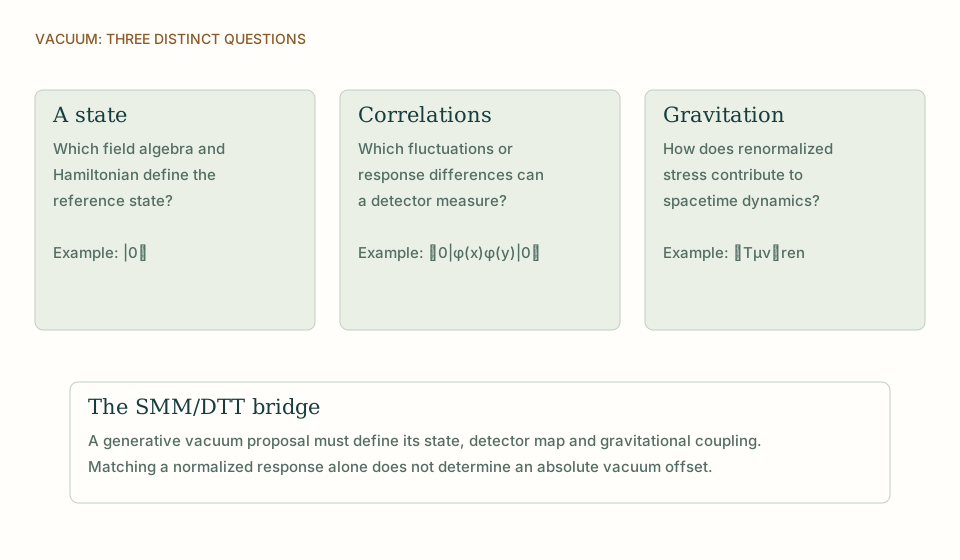
Semiclassical gravity couples a classical metric to the renormalized expectation value of quantum stress-energy. Quantum fields propagate on that metric, and their averaged energy and pressure contribute to its dynamics. The approximation is useful in regimes where a mean field description is adequate; it need not remain reliable when metric fluctuations or stress-energy fluctuations become essential. Renormalization also introduces allowed local gravitational terms, whose parameters require specification.
This is a natural intermediate target for DTT because a source-generated field state and an effective geometry must eventually influence one another consistently. Recovering a field equation on a prescribed background is weaker than deriving that feedback. Covariant stress-energy conservation is particularly important: arbitrary time dependence assigned to vacuum energy cannot be inserted into Einstein’s equation without a consistent pressure or exchange law. A valid source contribution would derive a conserved effective stress tensor from the same dynamics that generates records. A microscopic temporal interpretation alone does not fix the finite vacuum term or the domain of the semiclassical approximation. [2]
Semiclassical gravity provides a quantitative horizon entropy and a relation between quantum fields, geometry and thermodynamics. DTT’s source archive can supply a possible microscopic interpretation of inaccessible information, but it must reproduce more than the fact that observers lack access to some records. The entropy coefficient, the horizon temperature and their variations are linked in the gravitational theory.
The finite-register calculation shows what an exact microscopic count would have to yield. A memory capacity independent of physical area would fail the area law, while a capacity selected after fixing the desired entropy would not explain it. A DTT model could become substantive by deriving a constraint that makes the number of independent completed states depend on the effective horizon area. The same construction should identify which states contribute to the accessible entropy and which are redundant source descriptions. Semiclassical backreaction then tests whether the counting is consistent with energy exchange. This comparison turns the broad idea of a temporal screen into a coupled problem of state counting, geometric reconstruction and thermodynamic response. [2] [3] [4]
For a spherical horizon of radius R in four-dimensional Einstein gravity, area A=4πR² and entropy S/kB=A/(4ℓP²)=π(R/ℓP)². If a finite source register has M equally accessible orthogonal states, its maximum entropy is kB ln M. Matching the horizon formula would require ln M=π(R/ℓP)², or M=exp[π(R/ℓP)²].
This is a matching requirement, not a derivation of M. For a toy radius R=10ℓP the required entropy is 100π kB, roughly 314 kB, corresponding to about 453 bits. The semiclassical formula is not quantitatively trustworthy for every Planck-scale toy radius; the example only displays the area dependence and conversion between natural logarithms and bits. A DTT model claiming temporal holography has to derive why its independent accessible record count obeys this relationship, rather than choose the register dimension to make it true. [2] [3] [4]
ℓP²=ℏG/c³. Entropy in bits is S/(kB ln 2). The finite-radius example illustrates counting, not a semiclassical measurement.
The positive research direction is to connect record accessibility, geometric area and gravitational dynamics in one construction. A source may retain information unavailable to a particular observer, making horizon-like restrictions conceptually natural. The nontrivial result would be a theorem linking that restriction to the effective metric and the correct entropy functional. Purely numerical agreement after selecting a memory dimension leaves the central explanatory relation open. [2] [3] [4]
THE SAME QUESTION, DIFFERENT STARTING POINTS
| Question | SMM/DTT | semiclassical gravity |
|---|---|---|
| Starting structure | One nonspatial source, retained memory and six nested inner functions with an outer completion interface. | Classical metric coupled to renormalized quantum stress-energy. |
| Observable connection | The source update and readout must generate the measured records and their calibrated relations. | A conserved effective stress and a controlled mean-field regime. |
| Horizon entropy and cosmic information | The finite-register calculation shows what an exact microscopic count would have to yield. | Semiclassical gravity provides a quantitative horizon entropy and a relation between quantum fields, geometry and thermodynamics. |
| Status of the claim | A constructive research programme; a specified finite model establishes only its stated conditional results. | An approximation; it does not supply complete quantum metric dynamics. |
KEEP THE CONNECTION
Connects this comparison with the author’s underlying construction.
Connects this comparison with the author’s underlying construction.
Connects this comparison with the author’s underlying construction.
Connects this comparison with the author’s underlying construction.
Places the comparison alongside the programme’s published results, assumptions and open targets.
References support the comparator and the specific mathematical or interpretive claims indicated. SMM/DTT connections are developed in the analysis above.
How these comparisons distinguish premises, results and physical claims