
In this article
- The question behind this comparison
- The SMM/DTT starting point
- How the comparator works
- The decisive comparison
- Worked benchmark
- What follows for the source programme


Ordinary quantum phase and hyperbolic time transformations preserve different mathematical structures. Comparing DTT with QBism, this article works through real rotation and boost generators, explains how real dynamics can select a complex structure, and identifies the further steps connecting that result to observable quantum physics.
Quantum phase is a relation among amplitudes that becomes observable when alternatives recombine. An overall phase multiplies all amplitudes equally and does not change ordinary measurement probabilities; a relative phase can change them sharply. The relevant scalar unit in standard quantum mechanics obeys i²=−1. A split-complex unit j with j²=+1 describes a different algebra and cannot simply replace i while preserving the usual positive probability rule.
The DTT programme can connect temporal organization to phase by asking whether real source dynamics selects a compatible complex structure. Such a selection is a mathematical statement about an operator and the symmetries that commute with it. It is more specific than calling one temporal role imaginary. Establishing a complex structure does not yet establish the Hamiltonian, the Born rule or the physical meaning of its phase scale. [3] [4]
The Single Monad Model begins with one nonspatial generative source. The Duality of Time Theory distinguishes the source’s inner production from the outer order in which completed records become accessible. Its six inner levels are nested functional roles of one process: a higher role organizes lower-level work. The seventh is the completion or observation interface. They are neither six independent clocks nor six additional time coordinates.
This distinction supplies a useful research question: which features of an observed world can follow from the way a source produces, retains and releases information? A concrete answer needs a state space, an autonomous update, retained memory and a rule connecting completion to an accessible measurement. In the constructions discussed here, those mathematical ingredients are stated explicitly. A successful finite example establishes what its specified mechanism can do; further arguments connect it to physical particles, spacetime or universal laws. [1]
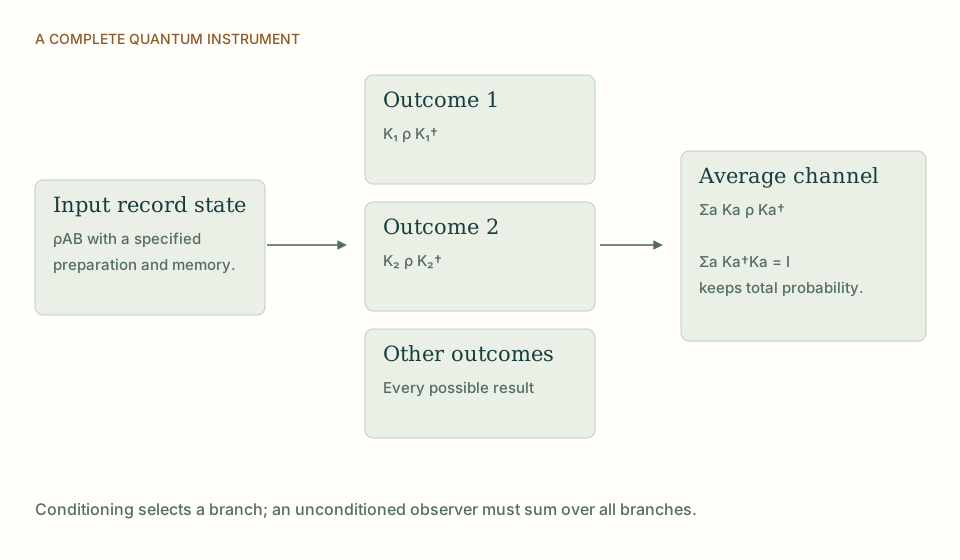
QBism interprets quantum probabilities as an agent’s personal expectations for the consequences of actions on the world. The quantum state belongs to that probability assignment rather than serving as a complete observer-independent description of the system. The Born rule acts as an additional normative constraint among an agent’s probability judgments. QBism does not deny an external world; it rejects an interpretation in which the state is simply a catalogue of its intrinsic properties.
The Single Monad Model has a much stronger ontological ambition: one source is intended to explain the production of physical multiplicity. A mathematical DTT model can still use an operational probability interface, but equating that interface with QBism would obscure this difference. The informative question is whether a proposed generative law imposes new, testable restrictions on the probabilities an agent should assign. If it does not, the two views can organize the same data while offering substantially different accounts of what the formalism means. [2]
QBism treats complex amplitudes as a compact representation of an agent’s probability assignments, rather than as an automatically ontic wave evolving in an unseen temporal plane. DTT’s phase-selection programme asks whether the same complex representation can arise from a physically constrained real source. The two claims concern different explanatory levels: one concerns the use of the calculus, the other its possible origin in a model of the world.
The valuable comparison is therefore not whether imaginary numbers are real entities. It is whether the source architecture selects the operational relationships that complex quantum theory captures. The J example demonstrates that complex rotations can be represented entirely by real matrices, so the presence of i in a formula alone does not prove an extra time. A stronger DTT result would show why a particular compatible J is forced and why its associated tests have the quantum probability structure. That result could be used by a QBist as a constraint on expectations without obliging the agent to equate a state vector with the source itself. Physical novelty still requires consequences beyond a change of representation. [2] [3] [4]
On a real two-dimensional space take J=[[0,−1],[1,0]]. Direct multiplication gives J²=−I. The exponential of θJ is cosθ I+sinθ J, a rotation that preserves x²+y². Identifying (x,y) with z=x+iy converts that same real evolution into z↦e^{iθ}z. No second physical time coordinate was introduced.
By contrast, K=[[0,1],[1,0]] obeys K²=I. Its exponential is coshη I+sinhη K and preserves x²−y². This hyperbolic transformation is appropriate for an indefinite quadratic form, not the Euclidean norm that supplies an ordinary one-component Born probability. A temporal reconstruction may use both structures in different roles, but it needs a map explaining how they coexist. Substituting η=iθ is an analytic continuation of formulas; it is not a demonstration that a physical process rotates one type of time into the other. [3] [4]
θ and η are dimensionless. The two matrices preserve different bilinear forms and have different spectral properties.
This comparison turns a suggestive dual-time vocabulary into a testable algebraic question: what physical constraints select J, and which transformations preserve that selection? If several inequivalent complex structures remain allowed, further dynamics or boundary conditions are needed. A rank-three quaternionic readout can organize rotations and phase actions, but its algebraic rank must not be mistaken for a proof of an emergent three-dimensional metric manifold. [3] [4]
THE SAME QUESTION, DIFFERENT STARTING POINTS
| Question | SMM/DTT | QBism |
|---|---|---|
| Starting structure | One nonspatial source, retained memory and six nested inner functions with an outer completion interface. | An agent’s probability assignments for actions and experiences. |
| Observable connection | The source update and readout must generate the measured records and their calibrated relations. | An outcome informs that agent’s subsequent expectations. |
| Quantum phase and complex structure | The valuable comparison is therefore not whether imaginary numbers are real entities. | QBism treats complex amplitudes as a compact representation of an agent’s probability assignments, rather than as an automatically ontic wave evolving in an unseen temporal plane. |
| Status of the claim | A constructive research programme; a specified finite model establishes only its stated conditional results. | Interpretation of quantum probabilities rather than a unique hidden source dynamics. |
KEEP THE CONNECTION
Connects this comparison with the author’s underlying construction.
Connects this comparison with the author’s underlying construction.
Connects this comparison with the author’s underlying construction.
Connects this comparison with the author’s underlying construction.
Places the comparison alongside the programme’s published results, assumptions and open targets.
References support the comparator and the specific mathematical or interpretive claims indicated. SMM/DTT connections are developed in the analysis above.
How these comparisons distinguish premises, results and physical claims
SMONAD
Share this page, or keep a clear reference to the work you are reading.
Use this reference for the explanation on this page. “n.d.” means its first publication date is not specified; the update date is recorded separately.