
In this article
- The question behind this comparison
- The SMM/DTT starting point
- How the comparator works
- The decisive comparison
- Worked benchmark
- What follows for the source programme


A metaphysical origin and a physical singularity are different explanatory targets. Comparing SMM/DTT with semiclassical gravity, this article calculates divergent curvature in an otherwise simple radiation universe and examines how a nonspatial source could replace an incomplete geometric description with finite, controlled records and a recoverable cosmological history.
The hot big bang describes an early dense phase of the observable universe; a singularity theorem or divergent classical solution concerns the limits of a particular spacetime description. Neither statement is automatically a theory of metaphysical creation from nothing. The Single Monad account addresses ontological origin, while a mathematical DTT cosmology must separately show whether its effective trajectories avoid incomplete or divergent physical evolution.
This distinction is constructive rather than merely cautious. A pre-geometric source could remain well-defined where a continuum metric ceases to be useful. To establish a physical resolution, however, the model needs a readout that yields controlled observables through the transition and a rule relating their clock readings. A finite number of inner stages does not by itself bound curvature or guarantee a smooth bounce. [2] [3]
The Single Monad Model begins with one nonspatial generative source. The Duality of Time Theory distinguishes the source’s inner production from the outer order in which completed records become accessible. Its six inner levels are nested functional roles of one process: a higher role organizes lower-level work. The seventh is the completion or observation interface. They are neither six independent clocks nor six additional time coordinates.
This distinction supplies a useful research question: which features of an observed world can follow from the way a source produces, retains and releases information? A concrete answer needs a state space, an autonomous update, retained memory and a rule connecting completion to an accessible measurement. In the constructions discussed here, those mathematical ingredients are stated explicitly. A successful finite example establishes what its specified mechanism can do; further arguments connect it to physical particles, spacetime or universal laws. [1]
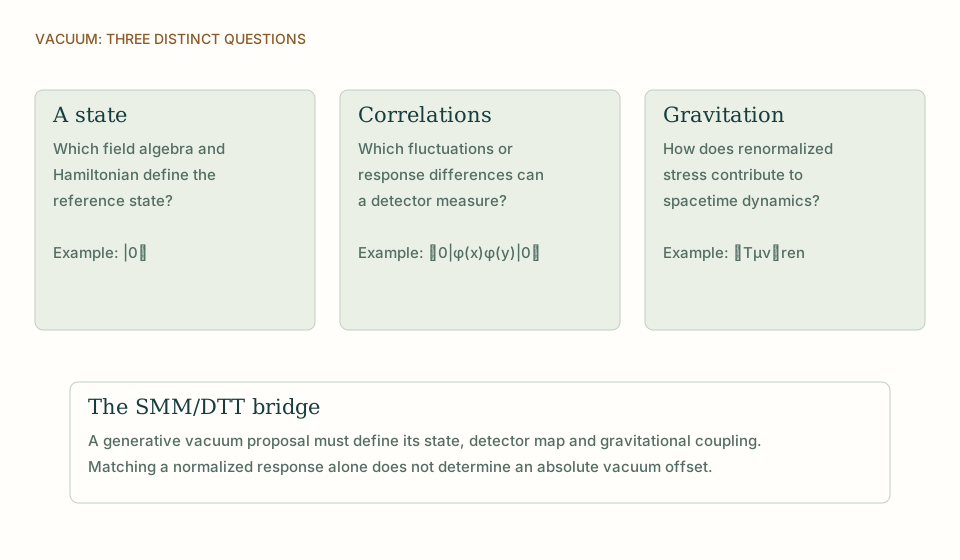
Semiclassical gravity couples a classical metric to the renormalized expectation value of quantum stress-energy. Quantum fields propagate on that metric, and their averaged energy and pressure contribute to its dynamics. The approximation is useful in regimes where a mean field description is adequate; it need not remain reliable when metric fluctuations or stress-energy fluctuations become essential. Renormalization also introduces allowed local gravitational terms, whose parameters require specification.
This is a natural intermediate target for DTT because a source-generated field state and an effective geometry must eventually influence one another consistently. Recovering a field equation on a prescribed background is weaker than deriving that feedback. Covariant stress-energy conservation is particularly important: arbitrary time dependence assigned to vacuum energy cannot be inserted into Einstein’s equation without a consistent pressure or exchange law. A valid source contribution would derive a conserved effective stress tensor from the same dynamics that generates records. A microscopic temporal interpretation alone does not fix the finite vacuum term or the domain of the semiclassical approximation. [2]
Semiclassical gravity may signal its own breakdown near a classical singularity because the quantum state, backreaction or metric fluctuations become uncontrollable. SMM/DTT’s nonspatial source offers a possible underlying description that need not fail at the same point. The real comparison concerns whether its completed observables remain finite and consistent when the mean-metric approximation is no longer adequate.
A minimum source step can regularize a numerical expression for curvature, but that alone does not establish geodesic completeness or a unique continuation of matter evolution. The radiation calculation gives one invariant target and illustrates why several observables are needed. A DTT model could replace the divergent classical regime with a finite transition map, then derive the classical solution as a late effective limit. Its energy and clock calibration must remain consistent across that map. This would be more informative than asserting that re-creation makes every instant new and therefore prevents singularities. The comparison encourages a precise statement of what is resolved: a divergent invariant, an incomplete trajectory, an ill-defined state or the separate ontological question of why the world exists. [2] [3]
For a spatially flat radiation-dominated classical solution, a(t)∝t^{1/2} for t>0. Thus H=1/(2t) and ä/a=−1/(4t²). The Kretschmann scalar for this flat FLRW metric is K=12[(ä/a)²+H⁴]/c⁴, giving K=3/(2c⁴t⁴). The Ricci scalar is zero in this ideal radiation case, yet K diverges as t approaches zero.
This is an instructive warning against checking only one curvature scalar. A DTT readout that makes R finite has not necessarily removed the singularity. A discrete regulator can keep individual computed values finite at a minimum step, but a physical resolution also asks what replaces earlier clock readings, whether matter evolution is well posed and whether the regulated predictions remain controlled under refinement. The source may be ontologically prior to the geometry without the model having proved those dynamical properties. The calculation identifies a concrete invariant against which a proposed early-universe completion rule can be assessed. [2] [3]
t is proper cosmological time in seconds and K has units m⁻⁴. The divergence belongs to the stated classical solution.
A useful theory of origin can therefore have two linked layers: an ontological account of why there is a world and a dynamical account of which physical description applies near the edge of an effective spacetime. DTT’s source–record distinction is suited to articulating that relationship. Its physical achievement should be judged by finite, stable observables and a recoverable cosmological history, rather than by the absence of a time coordinate in a metaphysical starting statement. [2] [3]
THE SAME QUESTION, DIFFERENT STARTING POINTS
| Question | SMM/DTT | semiclassical gravity |
|---|---|---|
| Starting structure | One nonspatial source, retained memory and six nested inner functions with an outer completion interface. | Classical metric coupled to renormalized quantum stress-energy. |
| Observable connection | The source update and readout must generate the measured records and their calibrated relations. | A conserved effective stress and a controlled mean-field regime. |
| Big bang singularity and origin | A minimum source step can regularize a numerical expression for curvature, but that alone does not establish geodesic completeness or a unique continuation of matter evolution. | Semiclassical gravity may signal its own breakdown near a classical singularity because the quantum state, backreaction or metric fluctuations become uncontrollable. |
| Status of the claim | A constructive research programme; a specified finite model establishes only its stated conditional results. | An approximation; it does not supply complete quantum metric dynamics. |
KEEP THE CONNECTION
Connects this comparison with the author’s underlying construction.
Connects this comparison with the author’s underlying construction.
Connects this comparison with the author’s underlying construction.
Connects this comparison with the author’s underlying construction.
Places the comparison alongside the programme’s published results, assumptions and open targets.
References support the comparator and the specific mathematical or interpretive claims indicated. SMM/DTT connections are developed in the analysis above.
How these comparisons distinguish premises, results and physical claims
SMONAD
Share this page, or keep a clear reference to the work you are reading.
Use this reference for the explanation on this page. “n.d.” means its first publication date is not specified; the update date is recorded separately.