
Local relational operations can produce exact neighborhoods and causal bounds. Relativity additionally requires calibrated matter clocks and physical realization of the geometric frame symmetries.
Does one source imply instantaneous action everywhere?
It would if the source were simply granted an unrestricted communication channel between every pair of records. SMM need not make that assumption. A pre-spatial source can have a structured operation algebra whose completed transitions define adjacency. Locality then concerns which observable effects those operations permit, rather than the source’s location in an already existing space.
The strongest objection asks whether a hidden controller can bypass the locality drawn into its output. That is a concrete model question. All state-carrying memory, routing and apparatus interactions must enter the physical update law. A successful construction proves both that records have the intended neighborhoods and that influence propagates only through those relationships. Neither claim can substitute for the other.
Deriving a local neighborhood from operations
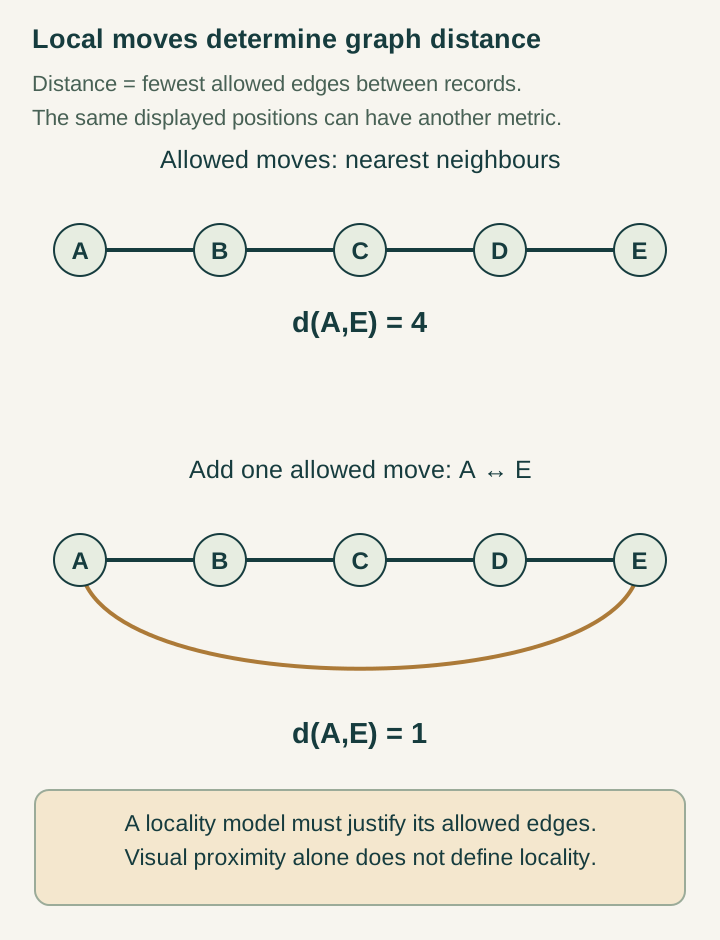
Take three commuting reversible operations that increment three labels modulo seven. The archive has 7³=343 completed records. Two records are adjacent if one operation or its inverse connects them. This is a graph defined by operational relations; coordinates are a convenient description of its structure.
The shortest nonzero return uses seven steps. A radius-two induced neighborhood agrees with the infinite cubic lattice because seven exceeds 2R+1=5. It contains one centre, six sites at distance one and eighteen at distance two, totaling twenty-five. This exact result establishes local cubic adjacency even though the global archive is periodic. It does not determine a Euclidean metric: shortest edge-count distance is initially the graph’s Manhattan distance. Isotropic physical comparisons require another measurement or a justified limit.
Open the full-size diagram →
Why a local update preserves that neighborhood
Give each site local registers and distinct edge ports. Let one completed episode consist of an on-site operation followed by a single layer exchanging only designated neighboring ports. The port pairs are disjoint, so the edge layer does not conceal additional sequential travel. An observable initially supported on X can gain support only on neighbors of X during one episode.
Induction gives support after k episodes inside the graph neighborhood B(X,k). Applying the same one-step argument to the previous support proves each induction step. This is an exact circuit result with a declared interaction architecture. A distant arbitrary swap or a controller carrying unknown state between nonadjacent sites would change that architecture and invalidate the bound. The source mechanism must account for such channels before claiming physical locality.
How a support bound becomes a causal speed
Assign an independently calibrated edge length ℓ and an episode duration ΔT. The graph bound supplies propagation slope at most ℓ/ΔT. If ℓ=2 length units and ΔT=3 clock units, five episodes permit at most ten length units in fifteen clock units, again giving 2/3. Counting a completed episode as one tick is insufficient unless a material clock establishes its duration.
More generally, assume each completed operation has positive delay Θ and displacement satisfying ‖Δx‖≤c⋆Θ. Concatenation preserves this cone: the triangle inequality gives ‖ΣΔx‖≤Σ‖Δx‖≤c⋆ΣΘ. This is a useful exact compositional theorem. Identifying its slope with a universal physical light speed requires the same calibrated bound to govern the relevant matter and signals, rather than only a selected circuit or propagation band.
From a cone symmetry to physical relativity
Once an interval T²−x² with T=ct is supplied, the boost T′=γ(T−βx), x′=γ(x−βT) preserves it. For β=3/5, γ=5/4. The event separation T=5,x=3 becomes T′=4,x′=0, preserving sixteen. Split-complex multiplication is one exact way to express this hyperbolic transformation.
The model must still show that real clocks, rods and moving apparatus realize those transformations. A geometrical automorphism is not automatically an available observer. A sufficient group-theoretic condition is physical realization of all spatial rotations plus transitivity on future unit timelike directions within the proper orthochronous Lorentz group. Any desired boost can then be matched on the rest direction by a physical transformation; their difference fixes rest and is a physical rotation. The remaining challenge is deriving those operational conditions.
Why a programmed lattice is an important first step
The finite archive proves that a common update can support local records. Explaining why that structure forms and persists is stronger. A source may use a structured initial register, a restricted family of operations or a repair process. Each possibility must disclose its preparation and memory resources. Statistical rarity results for unstructured random operation tables do not rule out all these mechanisms, but they show why selection cannot simply be assumed.
Perturb the neighborhood tables and inspect shortest unintended paths as well as the fraction of local errors. One shortcut can change a large-distance route even if almost every edge remains correct. Then perturb the dynamics and bound influence leakage. These tests turn emergent locality into a quantitative stability problem. The six nested inner roles can organize formation and verification, while outer completion must expose a usable archive with its actual preparation duration.
What a successful source reconstruction would deliver
The strongest result would generate adjacency, metric comparisons, material clocks and propagation with one fixed interaction law. It would show that a private generative schedule does not furnish an extra public simultaneity detector. Across changing preparations, moving clocks would retain the derived calibration and matter would share the same causal structure.
A Lorentzian metric is an important kinematic output; gravitational field equations require additional dynamics relating geometry to matter. A local circuit bound likewise does not establish Einstein’s equations. These are concrete next targets rather than interchangeable slogans. The constructive answer is that locality and relativity can be approached through exact operational steps, and SMM/DTT gains explanatory strength wherever one source principle forces two of those steps to agree.
Continue with the articles
- Programmed geometry and spontaneous selection
Compare the draft’s explicit torus preparation with a mechanism that would naturally select geometry. A constructive example proves feasibility while leaving the physical origin of its program open.
- Generating a neighborhood and preserving local transport
Separate reconstruction of spatial adjacency from the requirement that subsequent dynamics remain local. Explain the guarded transport rules used to preserve the generated metric.
- From a cone inequality to a Lorentzian metric
Explain the construction of a Lorentzian metric from a positive spatial metric and a temporal one-form. Identify the signature and nondegeneracy conditions required by the model.
- Limiting speed as update scale times projection rate
Introduce the draft’s relation between a spatial update scale, a projection rate, and the observed limiting speed. Explain why this relation alone does not fix a numerical value in laboratory units.
- Why light must share the same cone
Examine the additional assumption that electromagnetic dynamics inherit the constructed null geometry. A limiting cone in one sector does not automatically establish universal propagation across all fields.
- When geometric symmetries become physical boosts
Compare automorphisms of a mathematical geometry with transformations realized by physical observers. Explain why frame richness is an additional requirement for identifying the two.
- What Lorentzian reconstruction leaves open
Summarize the boundary of the constraint-relative theorem. Recovering a causal geometry does not itself determine matter dynamics, the numerical limiting speed, or Einstein’s field equations.