
Hyperbolic multiplication gives the standard boost formula once the calibrated interval and coordinate interpretation are supplied. A physical SMM/DTT derivation must additionally show that completed clocks, rulers and matter realize those transformations.
The invariant being preserved
For one spatial direction, let T=ct and define the interval Q=T²−x². Two inertial observers related by a Lorentz boost assign different T and x but the same Q. Timelike, null and spacelike separations therefore retain their classification.
This result concerns calibrated completed measurements. The DTT distinction between inner generation and outer completion is upstream of that coordinate description. A model can seek to generate the interval through record order and a positive cone, but it must identify which public readings become T and x. A formal pair of source variables does not automatically supply physical spacetime coordinates.
Deriving the boost matrix
Introduce a rapidity η and transform the coordinates by a hyperbolic rotation:
x′=cosh η ·x−sinh η ·T.
Expanding T′²−x′² cancels the mixed terms, leaving (cosh²η−sinh²η)(T²−x²)=Q. The primed origin has x′=0, so x/T=tanh η. Its velocity is therefore v=c tanh η. Defining β=v/c gives cosh η=γ=(1−β²)−1/2 and sinh η=γβ. The usual Lorentz formulas follow without any approximation.
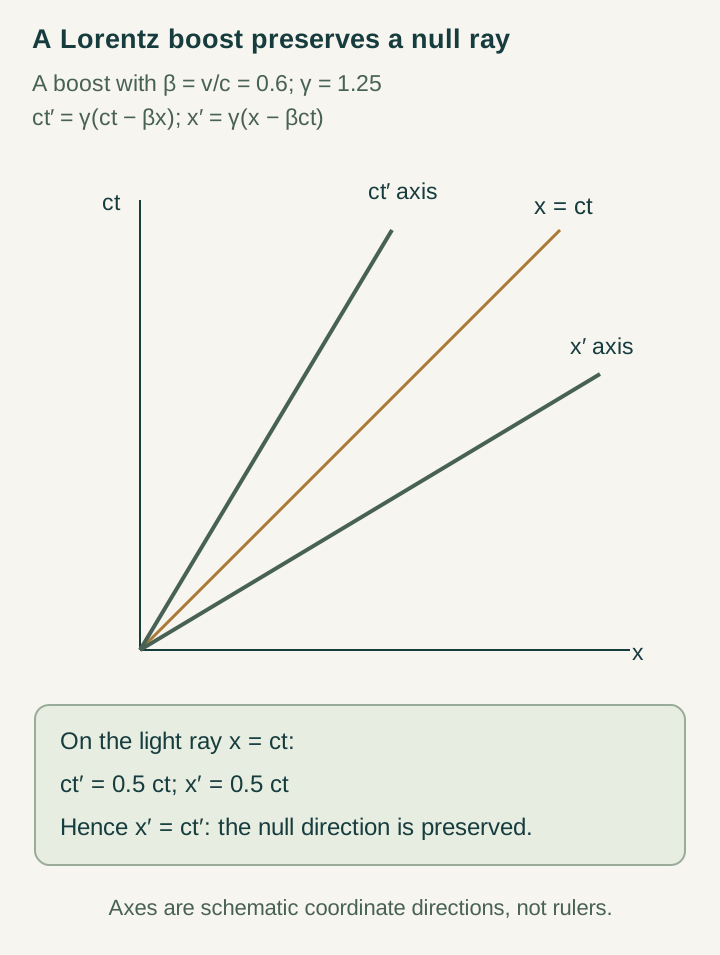
Open the full-size diagram →
Worked example: a timelike interval at rest
Choose β=3/5, so γ=5/4, sinh η=3/4 and η=log 2. Consider an event relative to the common origin with T=5 and x=3 in the same length units. The boost gives:
x′=(5/4)3−(3/4)5=0.
Both observers calculate Q=25−9=16=4². The primed frame places the two events at one spatial location, and their proper-time separation is four length units divided by c. This example connects the transformation to a measurable clock interval rather than treating the boost solely as a matrix identity.
What the split-complex unit does
Let j²=+1 and define z=T+jx, with conjugate z̄=T−jx. Its product zz̄ is T²−x². Multiplying by exp(−jη)=cosh η−j sinh η produces exactly the two coordinate formulas above and preserves the product.
This hyperbolic unit differs from an ordinary circular phase unit i with i²=−1, or a real quantum complex structure J satisfying J²=−I. The distinction is essential when DTT uses both coherent quantum phase and hyperbolic spacetime geometry. Their relationship must be provided by the source-to-record map; the two algebras cannot be exchanged merely because both are called complex.
Successive boosts and velocity addition
Boosts in the same direction compose by adding rapidities because their exponential generators agree. Applying the hyperbolic tangent addition identity then gives the velocity-composition law.
β₁=β₂=3/5 ⇒ β12=15/17.
The composed Lorentz factor is 17/8, consistent with cosh(2log 2). No superluminal result appears: for two subluminal velocities with the same sign, the denominator supplies precisely the required correction. Non-collinear boosts require the full three-dimensional Lorentz group and can include a spatial rotation; the one-dimensional split-complex picture does not replace that larger structure.
Simultaneous records depend on the frame
Take two events with ΔT=0 and Δx=4 length units in the unprimed frame. Under the same β=3/5 boost, ΔT′=−3 and Δx′=5. Their interval remains −16, so they are spacelike separated in both descriptions, although their time coordinates differ.
No clock runs backward along its own future-directed timelike path. The example compares two spatially separated events whose simultaneity depends on the coordinate convention associated with the inertial frame. For SMM/DTT, this makes a useful demand on completed observations: a private order used by the generative algorithm must not become an unaccounted universal simultaneity detector.
From geometric symmetry to physical observers
A cone can have boost symmetries even when the available matter clocks realize only a restricted set of motions. To identify geometric boosts with changes between equivalent observers, the apparatus must preserve its calibration and the theory must supply sufficiently many moving frames.
A useful conditional result takes the physical frame group to be a subgroup of the proper orthochronous Lorentz group SO⁺(1,3), assumes that all spatial rotations are physically realized, and requires transitivity on future unit timelike directions. For any Λ∈SO⁺(1,3), choose a physical g carrying the standard rest direction to Λ's rest direction. Then g⁻¹Λ fixes the rest direction and is a rotation. Both factors are physical, so Λ is physical as well. Parity and time reversal are discrete transformations outside this conclusion and require separate assumptions.
What a source reconstruction should establish
The six nested inner roles organize the formation of records; the seventh makes them publicly available. A relativistic source reconstruction should show that different admissible organizations or observer motions give equivalent completed predictions after the derived boost transformation. It should calculate the response of real clock and ruler patterns, not only transform their labels.
At finite resolution, violations may appear as direction-dependent dispersion or clock drift. Bounding those effects and proving a common limit would give the hyperbolic representation physical force. In curved spacetime the same construction applies locally; a single global boost need not relate observers throughout an inhomogeneous geometry.
Continue with the articles
- Simultaneity
Introduce simultaneity as a relation between events rather than a self-explanatory universal fact. Connect the concept to clock conventions and the role of completed records.
- From a cone inequality to a Lorentzian metric
Explain the construction of a Lorentzian metric from a positive spatial metric and a temporal one-form. Identify the signature and nondegeneracy conditions required by the model.
- One clock direction plus three readout directions
Explain the rank-one clock and rank-three readout used in the conditional four-dimensional construction. Clarify why a soldering map is needed to identify them with tangent directions.
- Symmetric cones and causal order
Introduce the homogeneous self-dual cone assumptions behind the Lorentz-cone result. Explain how symmetry and readout constraints narrow the possible ordered geometries.
- When geometric symmetries become physical boosts
Compare automorphisms of a mathematical geometry with transformations realized by physical observers. Explain why frame richness is an additional requirement for identifying the two.
- Four principles of quantum relativity: assumptions and consequences
Follow the four proposed principles through their mathematical dependencies. The guide connects complex temporal dynamics with SMM/DTT while identifying the extra assumptions needed to pass from an algebraic construction to a physical consequence.