
The metric assigns proper time by an integral along a worldline. A DTT clock must reproduce that integral through its completed internal dynamics, including any retained phase count and its response to motion or gravity.
A duration belonging to a worldline
In an inertial frame of flat spacetime, an ideal clock following velocity v(t) accumulates proper time according to dτ=dt√(1−v²/c²). The square root is real for a massive timelike clock. Integrating gives the total duration registered along its trajectory.
The formula is invariant under changes between inertial coordinates even though t and v separately change. In SMM/DTT, the completed worldline is a sequence of persistent records. The open construction problem is to show why a clock made from those records accumulates exactly this functional of its history.
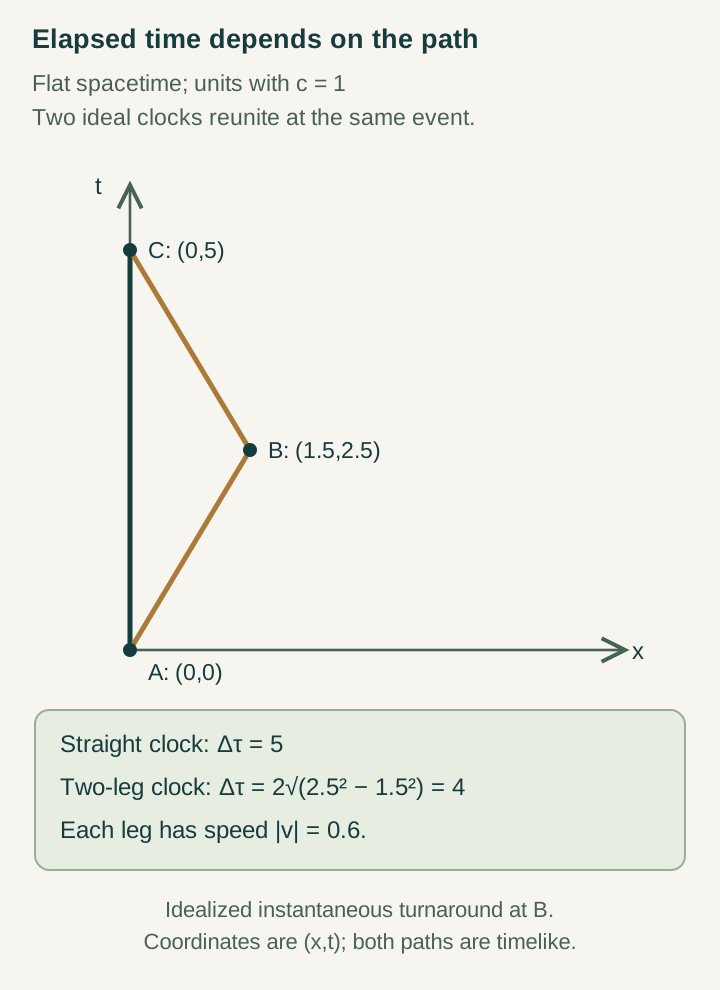
Open the full-size diagram →
Uniform motion and the clock factor
For constant speed, the integral reduces to Δτ=Δt/γ. At v=3c/5, γ=5/4, so a clock accumulates four time units during five units of the inertial coordinate time. Its own local processes remain regular when described using its own proper reading.
The comparison uses a synchronized inertial network or an equivalent operational procedure. Simply watching light arrive from a moving clock adds propagation and Doppler effects. Keeping those effects distinct prevents an observed signal frequency from being mistaken for the proper-time rate before travel-time corrections or a coincidence-based comparison have been specified.
Worked example: two histories between the same events
Let one clock remain at x=0 for five coordinate-time units. A second travels outward at 3c/5 for 2.5 units, reverses direction and returns at the same speed for another 2.5. In units with c=1, the turning event is (x,t)=(1.5,2.5). In the ideal limit of a negligibly short turnaround, its total proper time is:
τtravel=2.5×4/5+2.5×4/5=4.
The clocks reunite and can compare their records locally. A finite turnaround changes the detailed path and must be included in the integral. The calculation is not explained by assigning a mysterious aging cost directly to acceleration; acceleration allows a different reunion path, while the duration is computed along that whole path.
How a recurrent carrier can register the duration
Suppose a stable clock transition has rest angular frequency ω₀ and its phase responds locally as dφ=ω₀dτ. The accumulated unwrapped phase then gives τ=(φ−φ₀)/ω₀. This is a material realization of proper-time measurement once the coupling law is established.
DTT supplies a natural interpretation: internal activity sustains the clock, and completed phase records make duration readable. Yet an arbitrary source oscillator could respond to coordinate time, branch work or another internal parameter. The required proper-time law must be derived from the clock's dynamics. Cycle memory and a calibrated phase range are also needed because a circular display alone loses whole turns.
A conditional link to relativistic matter phase
For a free massive mode, assume the relativistic energy and momentum relations E=γmc² and p=γmv. Along its inertial trajectory, the plane-wave phase increment is (p·dx−E dt)/ℏ. Substituting dx=vdt gives:
dφ=−(mc²/ℏ)dτ.
This exact conditional calculation links rest recurrence to proper time through a Lorentz-covariant matter dictionary. A global phase of a single isolated energy eigenstate is not itself an observable clock hand. A readable clock requires a relative phase between states or paths and an appropriate reference and measurement.
Proper time in a static gravitational field
Use metric signature (−,+,+,+). In a static chart with no time–space cross terms, a stationary clock obeys dτ=N(x)dt, where N is the positive lapse. Two stationary clocks at different locations generally accumulate different proper times over the same coordinate interval.
For a weak static field, N≈1+Φ/c². The leading fractional rate difference is therefore ΔΦ/c². In a source model, a spatially varying completion response could motivate an effective lapse, but its identification must also reproduce matter motion and signal exchange. Adjusting a clock rate alone does not establish a gravitational metric.
When a material device is an ideal clock
An ideal clock's reading depends on its local proper-time history within its operating regime. A real device may also respond to acceleration-induced deformation, external fields, temperature or internal transitions. Those influences are apparatus dynamics to model and control; they do not redefine the geometric proper time.
The SMM/DTT protected-clock example addresses a different but complementary issue: whether one logical reading ignores a chosen class of inner operations. That protection is useful, but it does not by itself prove the relativistic clock hypothesis. A complete construction must combine operational protection with the correct response to physical motion and gravitational calibration.
The source-level comparison to pursue
Choose two distinct recurrent clock carriers, calibrate them together and transport them through the same timelike history. Derive their phases from the source update and compare them with the metric integral. Then use different histories ending at the same reunion event so that the predicted accumulated differences can be compared locally.
The six nested inner levels remain dependencies of one generator, not extra observable durations to be added to τ. The seventh completion interface must retain enough information to track phase turns, apparatus state and past influence. A successful common law would explain why different stable clocks agree on the same proper-time functional despite their different microscopic implementations.
Continue with the articles
- Relative and Curved Time
An introductory discussion of relative time and the geometric language of curvature. Prepare a careful comparison between historical temporal imagery and modern spacetime descriptions.
- Simultaneity
Introduce simultaneity as a relation between events rather than a self-explanatory universal fact. Connect the concept to clock conventions and the role of completed records.
- When an additive clock is unique
Explain the conditional uniqueness of a scalar clock up to positive rescaling for ordered rank-one returns. Distinguish additive delays from a globally defined event time.
- A protected material clock
Describe the model that realizes resolution-only evolution through protected couplings. Explain which interaction restrictions protect the clock and how a controlled perturbation breaks that protection.
- Why one clock model does not prove universality
Use the ungated-clock countermodel to show that a realizable clock law need not be physically universal. Explain the extra selection principle required for all material clocks to agree.
- Calibrating a conformal geometry
Explain why a causal cone fixes less than a fully scaled metric. Introduce the record-density and clock standards used to supply the remaining scale in the draft.
- When geometric symmetries become physical boosts
Compare automorphisms of a mathematical geometry with transformations realized by physical observers. Explain why frame richness is an additional requirement for identifying the two.
- Four principles of quantum relativity: assumptions and consequences
Follow the four proposed principles through their mathematical dependencies. The guide connects complex temporal dynamics with SMM/DTT while identifying the extra assumptions needed to pass from an algebraic construction to a physical consequence.