


Define the velocity before assigning a number
The expression α=v/c is meaningful only after v is defined. In the supplied Coulomb ground state, the relevant quantity is the root-mean-square relative velocity √⟨p²⟩/μ. It is not a circulating classical trajectory and not the mean velocity vector, which is zero in the real stationary state.
Let κ=αℏc after electromagnetic matching. In this chapter α is an adjustable model input. The laboratory explores the consequences of choosing it; it does not determine the physical fine-structure constant. The book explicitly separates a structural count, a normalized response coefficient, and a measured dimensionless coupling. [M07]
There are two masses: an electron mass me and a nuclear mass M. Define R=M/me and q=μ/me=R/(1+R). The relative coordinate uses μ, while the electron's centre-of-mass-frame velocity uses me.
Follow four linked consequences
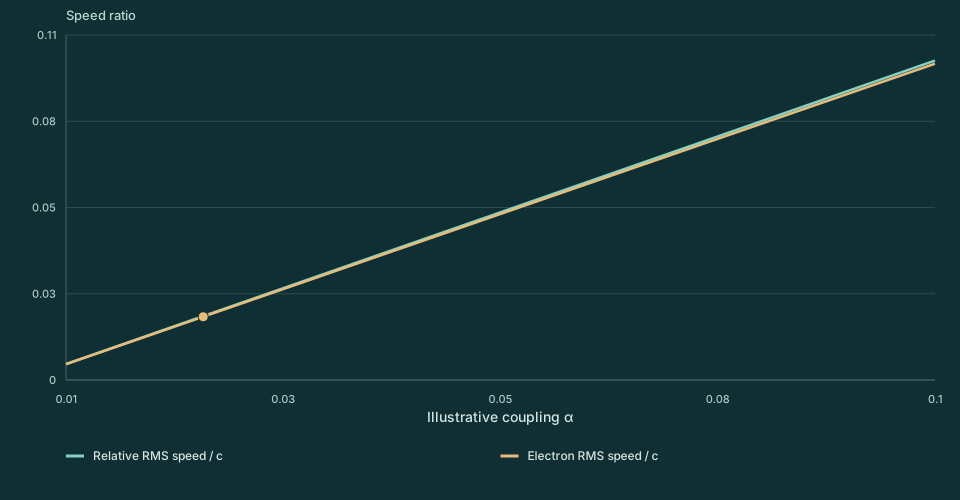
Vary α and the mass ratio. The readout reports radius in electron Compton-length units, binding energy in electron rest-energy units, relative RMS speed, and electron RMS speed. These dimensionless choices avoid inserting a separate measured numerical constant into every calculation.
Interactive calculation
Change the inputs to compare the model outputs.
Enable JavaScript for adjustable values. The static figure and worked calculation remain available.
For the illustrative values α=0.1 and R=1, q=1/2. The radius is 20 electron Compton lengths, the binding magnitude is 0.0025mec², the relative RMS speed is 0.1c, and each equal-mass constituent has RMS speed 0.05c in the centre-of-mass frame.
Doubling α halves the radius and multiplies the binding magnitude by four. It doubles both RMS speeds. Raising the nuclear mass instead drives q toward one. The relative RMS speed stays fixed at the selected α, while the electron speed, radius, and binding energy respond through q.
Derive the powers from one Hamiltonian
The first identity is the Coulomb virial relation. It follows by applying a normalized dilation to a stationary bound state: the kinetic expectation scales quadratically and the inverse-distance potential linearly. Stationarity of the energy makes their first-order variation vanish.
The electron and nucleus have opposite momenta in the centre-of-mass frame. Dividing that common momentum magnitude by different masses gives their different speeds. For a level with principal quantum number n, the relative RMS ratio becomes α/n within the same nonrelativistic Coulomb model.
The radius-energy product is a useful check: multiplying the two dimensionless expressions gives α/2, independent of R. By contrast, the product of radius and relative RMS speed is 1/q. These distinct dependencies provide more information than any one output alone.
An equal-mass example is especially informative because it makes the reduced-mass distinction large. It avoids treating a small correction as negligible by habit. In an actual identification of a material pair, annihilation, spin, and additional interactions would require their own terms beyond the scalar baseline used here.
A coupling derivation must enter upstream
Every positive α in this mathematical family yields a normalizable ground state. Requiring binding therefore cannot select a unique α. A source derivation must fix the interaction relative to the action and propagation scales before those atomic consequences are used as tests. [M07] [M08]
The largest slider values are useful for displaying the scaling law, but quantitative physical use of this nonrelativistic model requires α to be small enough that omitted relativistic terms are controlled. For real precision spectroscopy, radiative, recoil, nuclear-size, and other corrections also matter. The lab's exact arithmetic belongs to its declared baseline.
SMM/DTT becomes more predictive when one inner-generation mechanism constrains all four readouts with fewer independently selected inputs. It should retain the same dictionary across binding, propagation, and clock measurements instead of recalibrating each sector separately. [M09]
Continue to state preparation. The original alpha-and-electron-motion guide explains the relative/electron distinction in more detail, and the constants explorer tracks broader parameter dependencies.