


State amplitudes and directions are different objects
Spin describes a transformation law of an internal state. A spin-half carrier is represented by a normalized complex pair, and directional measurements are built from the Pauli matrices. This is a mathematical representation supplied to the present laboratory. A source reconstruction must explain why the relevant material excitation carries it.
The distinction matters for SMM/DTT because an inner description may retain more information than a particular outer test exposes. Two spinors differing by an overall sign give identical isolated probabilities, while a coherent comparison with another branch can reveal that sign as a relative phase. The meaning of a completed record depends on the admitted comparison. [B24] [M06]
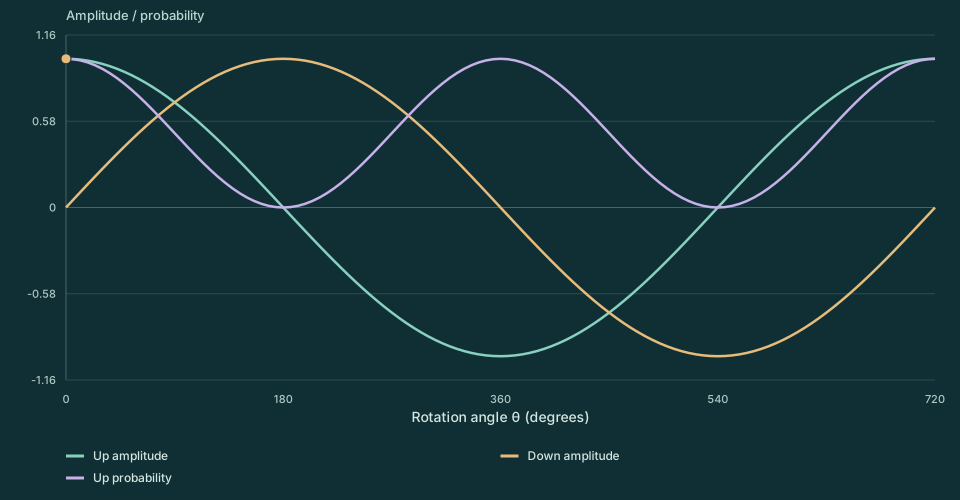
Here the initial state is |↑z⟩=(1,0)ᵀ. We rotate about the y axis so the displayed amplitudes stay real. This makes the half-angle relation visible without obscuring it behind complex notation.
Compare a full turn with two full turns
Move the rotation angle from 0 through 720 degrees. The two signed amplitudes pass around a circle at half the angle of the directional readout. The probability of an up-z outcome is the square of the first amplitude.
Interactive calculation
Play scans Rotation angle θ (degrees). Step advances it. No animation starts automatically.
Enable JavaScript for adjustable values. The static figure and worked calculation remain available.
At 180° the state is (0,1), so the z test gives down with certainty. At 360° it is (−1,0): the spinor has changed sign, but the up probability is again one. At 720° both the amplitudes and the directional vector have returned to their starting values.
At 90° the two amplitudes are 1/√2 and both z outcomes have probability one half. The directional vector points along +x. Thus equal outcomes in one chosen basis do not mean that the state has lost its directional information.
The half-angle follows from the chosen generator
The identity σy²=I lets us separate the exponential into even and odd powers. The factor one half is part of the supplied spin-half representation. It is responsible for R(2π)=−I and R(4π)=I.
The directional vector has ordinary 2π periodicity because each component is quadratic in ψ. The density operator ψψ† also has that periodicity. A detector acting only on the isolated state therefore cannot distinguish ψ from −ψ.
For a different experiment, place the spinor in two coherent paths and rotate only one path by 2π. The relative path state changes from (|a⟩+|b⟩)/√2 to (|a⟩−|b⟩)/√2. A balanced recombiner can distinguish those states. This argument requires a coherent reference path and a controlled operation; it does not turn an isolated global sign into an observable.
Keep the measurement axis fixed while changing the state rotation. Rotating the apparatus together with the state is a different comparison and can preserve every reported outcome. An operational statement therefore specifies which transformation acts on the carrier and which reference remains unchanged.
What spin does and does not establish
A rotation law does not by itself establish fermionic exchange statistics. Exchange concerns composition and interchange of identical excitations, and connecting it with spin requires the appropriate many-particle and locality assumptions. A finite two-component drawing cannot substitute for those conditions. [M10]
Nor does the spinor alone determine a magnetic moment, a gauge group, or a force strength. Those require compatible dynamics and response operators. The book's transport discussion explains how local basis changes constrain comparison maps; selecting a physical interaction is a further step. [M06]
The published rank-three and phase-selection work provides mathematical context for the relation between carriers, imaginary structures, and directional readout. The present lab is an explicit Pauli example with declared inputs, rather than an independent derivation of the electron from that context. [P01] [P03]
Continue to binding to ask what holds a composite pattern together. The original spin-and-transport guide develops loop comparisons, and Phase explores the difference between common and relative phase.