


A spectral line connects two common energies
Spectroscopy compares stationary energy levels through emitted or absorbed radiation. In the ideal baseline here, the scalar Coulomb spectrum is En=−ER/n². A line has an energy difference, not an independent energy assigned separately from its endpoints.
This provides a strong consistency test for a common-source programme. Inner histories may contribute differently to different levels, but the completed predictions must belong to one compatible energy structure. If three transitions share three levels, their signed differences must close around the cycle.
The laboratory uses the same reduced-mass and coupling conventions as the atomic chapters. It explores energy positions and differences. It does not draw radiation from a classical orbit, calculate transition strengths, or assume every pair of levels is connected by an allowed electric-dipole transition.
Select two levels and compare the interval
Choose a lower and upper principal quantum number, then change the reduced-mass scale. The level positions and their positive separation update together. The zero line is the ionization threshold; bound levels accumulate toward it as n increases.
Interactive calculation
Change the inputs to compare the model outputs.
Enable JavaScript for adjustable values. The static figure and worked calculation remain available.
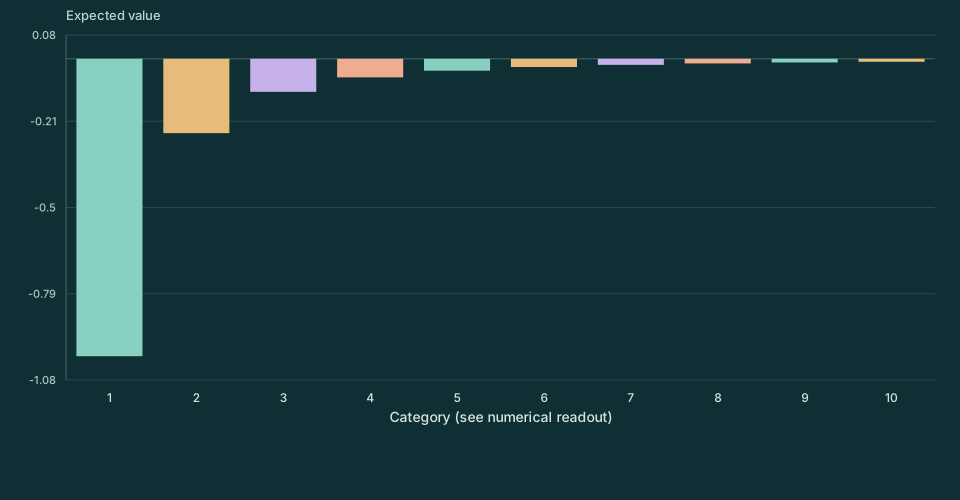
In units of ER, the 1→2 separation is 3/4, the 2→3 separation is 5/36, and the direct 1→3 separation is 8/9. The first two add to the third. Their ratio (2→3)/(1→2)=5/27 is independent of the overall binding scale.
Changing only the reduced mass scales every level and interval by the same factor at fixed coupling. The interval ratios remain unchanged in this leading model. A more complete atomic calculation can break this simple common scaling through recoil, nuclear, radiative, or other state-dependent effects.
Use shared levels rather than independent line offsets
For nhi>nlo, ΔE is positive. Absorption requires that energy; emission from the upper to the lower level releases it. A photon frequency would be ν=ΔE/h once the energy and clock dictionary is fixed.
The adjacent spacings shrink at large n. This is a feature of the supplied inverse-distance spectrum, not evidence by itself for a new temporal mechanism. The state labels also include angular and spin quantum numbers in more complete models; n alone cannot determine all allowed transitions or splittings.
A correction assigned to shared levels automatically preserves the cycle identity. For example, in three arbitrary levels let δE₁=0, δE₂=ε, and δE₃=0. The 1→2 interval changes by +ε, the 2→3 interval by −ε, and the 1→3 interval by zero. Separate adjustable corrections to all three lines would generally violate this constraint.
For q connected stationary levels, there are at most q−1 independent energy differences after choosing an energy zero. Measuring many lines is useful, but the number of distinct lines is not the number of independent level parameters.
Turn a source model into reserved predictions
A quantitative SMM/DTT proposal should first fix its source law, reduction, and common physical scales. It should then calculate a state-dependent operator correction and compare its consequences in observations that were not used to select those inputs. Reusing a fitted line as an independent test would confuse calibration with prediction. [M08] [M09]
The published reconstruction papers provide mathematical ingredients and conditional structures. This lab uses conventional Coulomb energies as a reference target; it is not a calculation of a new DTT spectral anomaly or a claim that unexplained residuals have been observed. [P01] [P02]
Precision comparison additionally requires an appropriate conventional baseline, correlated uncertainties, and control of external fields and nuclear effects. A useful new mechanism should predict a pattern across several levels, isotopes, or angular channels with fewer freely adjustable quantities than the observations constrain.
The original spectra-and-corrections guide develops compatible perturbations and transition networks. Continue to the source and model register, return to Observation for evidence and uncertainty, or follow Relativity to connect energy with physical clocks and inertial response.