


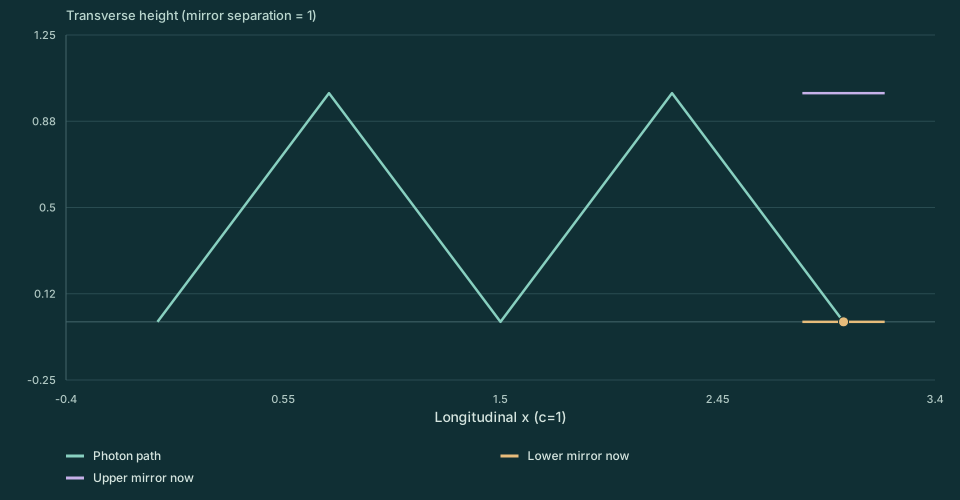
One repeatable process, two descriptions
Imagine a pulse reflected between two mirrors separated by a fixed transverse distance L in their rest frame. One complete return is a tick. The rest period is τ₀=2L/c. To function as a clock, the device must retain a count of returns; a moving spot without a memory of completed cycles does not measure an arbitrarily long duration.
Now view the entire apparatus from an inertial laboratory in which the mirrors move horizontally at speed v. During each half-tick, the light must reach a mirror that has changed horizontal position. Its path in the laboratory is diagonal. The derivation assumes that light travels at c in both inertial frames and that the transverse mirror separation is L in both descriptions.
The SMM/DTT question is how a generated material apparatus and a completed signal comparison realize these assumptions. The illustration derives a consequence of the supplied relativistic clock model. It does not derive the universal signal speed or mirror dynamics from the Monad. [R03] [B16]
Compare coordinate time and tick time
Adjust β=v/c. The numerical readout compares the laboratory interval with the duration accumulated by the moving clock. At zero speed the paths and rates agree. As |β| rises, the diagonal path is longer and the clock accumulates a smaller proper duration during a fixed laboratory interval.
Interactive calculation
Play scans Laboratory elapsed time t. Step advances it. No animation starts automatically.
Enable JavaScript for adjustable values. The static figure and worked calculation remain available.
At β=0.8, γ=5/3. A laboratory interval of five time units corresponds to three units on an ideal clock moving uniformly at that speed. The sign of v selects a direction, while the time-dilation factor depends on v². The laboratory picture is a coordinate reconstruction, not a photograph corrected for light travel time.
Playback advances the explanatory drawing. Its screen refresh rate is unrelated to the physical frequency of a mirror clock, and the moving marker is not experimental data.
Pythagoras for half a tick
The hypotenuse is the light path during half a tick. Its horizontal component is the mirror displacement vΔt/2, and its vertical component is L. Rearranging gives a laboratory tick duration larger than the rest duration:
The proper reading stays positive for every subluminal speed. A massive clock has no rest-frame light-clock construction at β=1. The divergence of γ describes a limiting relation, not an instruction to move a material apparatus at light speed.
For small β, expand the square root: Δτ/Δt=1−β²/2+O(β⁴). This provides a useful numerical check on the slider near rest. Doubling a sufficiently small speed multiplies the leading rate deficit by approximately four.
Why a light clock is not yet all clocks
Suppose two clocks use different mechanisms, such as an optical cavity and a relative atomic phase. For a universal relativistic reading, both must accumulate the same proper duration after their ordinary environmental responses have been accounted for. Reproducing one idealized light-clock diagram is insufficient to prove that agreement across all matter sectors. [R07]
A stable transition with angular frequency ω₀ can register a duration through a relative phase satisfying Δφ=ω₀Δτ, provided cycle counting and a measurement reference are available. The Phase journey explains why an isolated common phase is not automatically a readable clock.
The distinction between the source ordering and the public clock remains essential. Inner generation can be a proposed mechanism for maintaining the apparatus; outer observation compares its retained tick records. A physical theory must explain the calibrated link between those roles. [R01]
Continue to Lorentz boosts to see how the space and time coordinates transform together.