


A reunion makes the comparison local
Two clocks can be calibrated beside one another, separated, and later reunited. Their final readings can then be compared at one place. This removes the need to infer the difference merely by watching signals arrive from a distant moving clock, which would introduce additional propagation and Doppler effects.
In flat spacetime, the proper duration of an ideal massive clock is the integral of √(1−v²/c²) along its history, expressed in an inertial coordinate system. The integrand is local to each segment of the path. Two histories between the same endpoints can have different integrals.
This is a precise target for a generative account of clocks. A retained succession of completed records must encode the relevant accumulated duration, including a memory of whole phase cycles if a phase-based mechanism is used. Recurrence by itself does not establish the required rate law. [R01] [R03]
Take an outward and a return leg
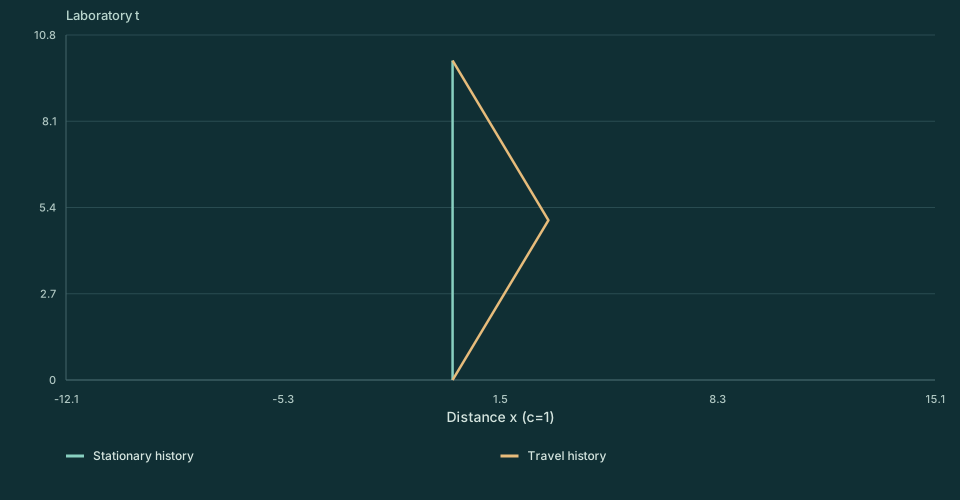
Choose a total laboratory duration T and a speed magnitude β. One clock remains at x=0. The traveller moves outward for T/2, reverses its velocity, and returns for T/2. Its turning point is x=βcT/2. Both worldlines end at the same reunion event.
Interactive calculation
Play scans Travel speed magnitude β. Step advances it. No animation starts automatically.
Enable JavaScript for adjustable values. The static figure and worked calculation remain available.
For T=10 and β=0.8, the stationary clock accumulates ten time units. Each five-unit travel leg contributes three proper-time units, giving six in total. The difference is four. At β=0 both histories coincide and the difference vanishes.
The corner represents an idealized turnaround with negligible coordinate duration. A real clock needs a smooth force-driven reversal, and its actual velocity during that interval must be included in the integral. The lab calculates the ideal piecewise inertial limit; it does not model stresses or acceleration sensitivity inside an apparatus.
Integrate the duration along each path
Changing the sign of velocity at the turnaround leaves β² unchanged. Both legs therefore contribute equally. The difference is a property of the full worldlines; assigning a separate universal loss of time to the instant of acceleration would not reproduce the integral for arbitrary journeys.
For any subluminal path in these inertial coordinates, √(1−β(t)²)≤1. Hence τ≤T. Equality requires zero velocity throughout except on sets of zero duration. This immediately shows why the stationary path maximizes the proper duration for these fixed coincident spatial endpoints in flat spacetime.
The phase relation is a specified material-clock law. A display showing only φ modulo 2π loses the number of complete revolutions. A clock therefore needs both a periodic process and a stable counting record. A common phase of one isolated energy eigenstate is not a freely readable phase hand.
Where the apparent symmetry ends
On either inertial leg the traveller can describe a moving Earth clock, but the traveller changes inertial frames at the turnaround. Combining the two descriptions requires a consistent reassignment of distant simultaneity. The reunion result is obtained without ambiguity by evaluating either worldline's invariant duration.
The source reconstruction must connect this geometric duration to the same matter laws that govern the clock. It must also identify the ideal-clock regime in which acceleration, external fields, and internal deformation do not produce additional apparatus errors. The book treats clock universality as a physical obligation extending beyond the existence of one periodic process. [R07]
The Observation journey follows the stability and comparison of records; the Matter journey examines persistent carriers. Continue to velocity composition, or consult the original Proper time guide.