


State the geometry and the observers
General relativity assigns clock rates through a metric. For the exterior of an ideal spherical, nonrotating, uncharged source with zero cosmological constant, the Schwarzschild solution supplies a particularly clear example. Define the Schwarzschild radius rₛ=2GM/c² and the exterior lapse N(r)=√(1−rₛ/r).
This lab concerns stationary observers at fixed areal radii r greater than rₛ. A stationary observer is supported against falling; it is not a freely falling clock. “Areal radius” means that a sphere at coordinate r has area 4πr². It is not generally the proper radial distance measured along a spatial ruler. [R08]
The displayed inputs are radii measured in units of rₛ. No particular star, planet, or black hole is being fitted. The exact metric and clock coupling are supplied as a standard GR target for the SMM/DTT reconstruction.
Exchange a periodic signal
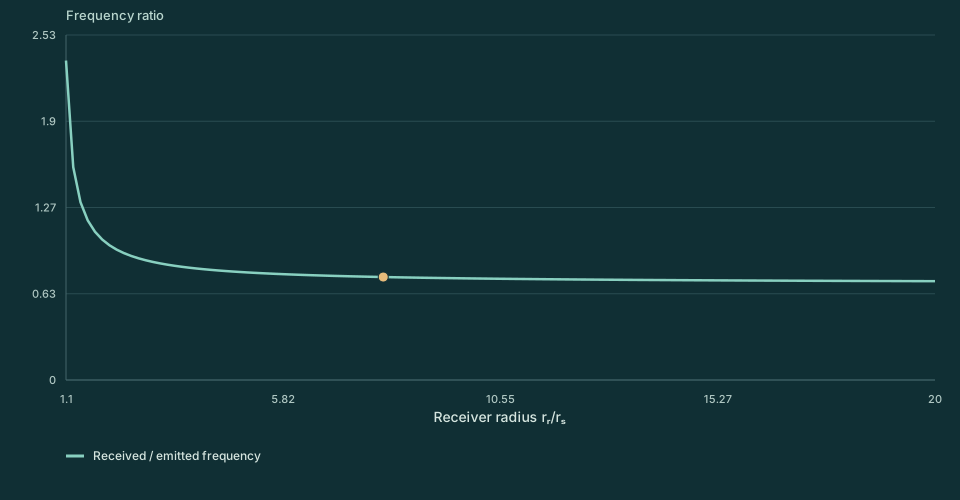
Choose an emission radius and a reception radius. The readout reports each lapse and the ratio of received frequency to emitted frequency. Moving the receiver outward relative to the emitter makes the received signal redshifted; exchanging the two positions gives the inverse ratio.
Interactive calculation
Change the inputs to compare the model outputs.
Enable JavaScript for adjustable values. The static figure and worked calculation remain available.
At remit=2rₛ and rreceive=8rₛ, the lapses are √(1/2) and √(7/8). The frequency ratio is √(4/7)≈0.755929. The receiver counts fewer signal cycles per unit of its own proper time than the emitter generated per unit of its proper time.
Equal radii give a ratio of one. The formulas apply only outside rₛ. Holding an observer stationary ever closer to the horizon requires increasingly strong support; a static observer at the horizon is not included. The drawing represents the comparison protocol, not a material funnel in which space sits.
Separate lapse, clock rate, and signal frequency
The time coordinate is normalized to the proper time of a stationary observer at infinity. For two fixed positions, successive pulses follow equivalent paths in a static geometry. Their coordinate emission and reception periods agree, while the local proper periods acquire different lapse factors.
This frequency ratio is the inverse of the receiver-to-emitter clock-rate ratio over the same coordinate interval. Keeping the numerator labels explicit prevents a common sign error. The laboratory reports frequency, so a lower ratio means redshift.
The approximation assumes |Φ|/c²≪1 and uses Φ=−GM/r for the exterior source. It agrees with the first-order expansion of the exact ratio. The book connects this clock effect and slow free fall through the same universal metric action. [R06]
A varying rate does not determine Einstein dynamics
An effective clock rate is one piece of a gravitational description. A complete theory also needs spatial comparisons, signal propagation, material trajectories, and field equations governing the metric. Fitting one lapse profile does not by itself derive the full Schwarzschild solution, the value of G, or universal coupling across different clocks. [R05]
For SMM/DTT, the useful test is whether one source dynamics yields a common geometry and the same response for distinct matter systems. Inner formation may motivate a variable completion response, but its identification with gravity must survive those additional comparisons. The source assumptions and coefficients should be fixed before testing a new regime.
Continue to the reconstruction laboratory, which makes clock agreement an explicit adjustable test. The existing Curved geometry guide and Inertial and gravitational mass guide develop the wider programme.