


Specify who measures each velocity
Suppose a laboratory sees a vehicle moving at speed v along its x-axis. In the vehicle's own inertial frame, an object moves at speed u in that same direction. Both quantities are ordinary measured velocities, but they belong to different frames. The question is what velocity w the laboratory assigns to the object.
At everyday speeds, w≈u+v is a good approximation. Near the invariant speed c, the conversion between the two time coordinates matters. The denominator in the relativistic rule comes from that time transformation; it is not an extra force slowing the object down.
The lab uses signed dimensionless inputs U=u/c and V=v/c. Negative values indicate opposite directions. It considers collinear inertial motion in flat spacetime. Accelerating frames, curved-spacetime comparisons over finite distances, and non-collinear boost rotations require additional structure.
Compose two subluminal motions
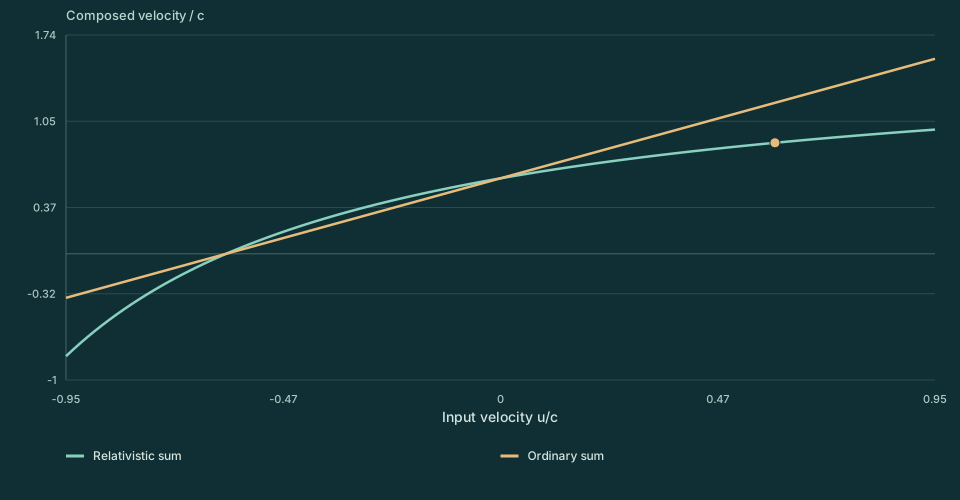
Move either velocity slider. Compare the relativistic result with the arithmetic sum, and follow the corresponding rapidities. Equal positive velocities produce a larger velocity that remains below c; equal and opposite velocities cancel.
Interactive calculation
Play scans Velocity u/c. Step advances it. No animation starts automatically.
Enable JavaScript for adjustable values. The static figure and worked calculation remain available.
For U=V=0.6, the arithmetic sum is 1.2, but the relativistic result is 1.2/1.36=15/17≈0.882353. If U=−V, the numerator vanishes and the combined velocity is zero. If one input approaches 1 while the other remains subluminal, the result approaches 1.
The equality w=c for a light signal can be checked by substituting U=1 into the formula, although a rest frame for that signal is not part of this construction. The sliders for material motions stay strictly inside the subluminal interval to keep their rapidities finite.
Derive the denominator from the clocks
Along the object's path in the vehicle frame, dx′=u dt′. Differentiate both inverse Lorentz formulas along that path and divide the resulting spatial increment by the time increment:
For |U|<1 and |V|<1, the right-hand side is positive, proving |W|<1. This algebraic check is more informative than merely restricting a graphical marker to a cone. It shows exactly where the preservation enters.
The hyperbolic tangent addition identity gives the same composition rule. Rapidity ranges over the real line even though velocity is bounded by c. In the example U=V=0.6, each rapidity is ln 2 and the combined rapidity is ln 4. The resulting Lorentz factor is cosh(ln 4)=17/8.
The low-speed approximation follows by expanding 1/(1+UV). The first correction to U+V is −UV(U+V); it becomes small when both dimensionless velocities are small.
What a common source must reproduce
The addition law links the boost geometry to measured transport. If a microscopic source model supplies one dispersion relation for matter and a different time calibration for apparatus, its measured velocity composition need not follow this rule. Recovering the same limiting speed across those ingredients is therefore a joint requirement. [R02] [B16]
The hyperbolic parameter also clarifies the connection with the two geometries of phase and spacetime. Adding circular phases and adding rapidities are parallel algebraic constructions with different preserved forms. Identifying their physical roles requires more than using the same word “rotation.” [B10]
Read the established derivation in the independent lecture notes, then continue to energy and momentum to see the same Lorentz structure act on the properties of a material mode. [R20]
The existing Lorentz transformations guide and Four principles guide place the calculation in the wider reconstruction programme.