
Conditional constructions already show how each principle can be represented consistently. The next advance is to derive the links between their clock, transport, energy and gravitational interfaces from fewer independent physical assumptions.
Four questions with different measurements
A limiting speed asks how quickly information can propagate. Lorentz symmetry asks how equivalent observers compare their records. Mass–energy equivalence connects rest energy to inertial response. Universal free fall asks why different matter systems respond to the same gravitational geometry.
SMM proposes a common source of all physical systems, while DTT distinguishes their inner generation from completed observations. This gives a strong organizing ambition: the source should generate geometry, material clocks and matter together. The six inner levels are nested dependencies within that process, and the seventh is the outer completion interface. Counting those roles does not by itself settle any of the four operational questions.
First principle: a common limiting speed
A local completed update can give a rigorous support bound. If one episode advances influence by at most length ℓ and has measured duration Δt, k episodes obey a corresponding bound with slope ℓ/Δt. A local unitary walk provides an explicit example.
The universal claim needs more: all relevant matter and signal sectors must inherit the same calibrated causal structure. A band group velocity, a maximal circuit support slope and the characteristic speed of a field equation are separately defined. A successful source law relates them in the appropriate limit and predicts finite-resolution departures instead of giving each an independently chosen matching value.
Second principle: Lorentz transformations
Once completed measurements possess interval c²dt²−|dx|², its boost symmetries have the usual hyperbolic form. In one spatial direction, split-complex multiplication with j²=+1 represents them exactly. Physical observers must also be able to realize those transformations with stable clocks and rulers.
The mathematical and operational tasks therefore complement one another. Cone reconstruction constrains possible geometry; apparatus covariance connects it to experiments. A source ordering can remain internal, but an observable preferred-frame effect would change the physical relativity claim. The correct test concerns transformed outcome probabilities and material calibrations, not the appearance of a familiar matrix.
Third principle: mass–energy equivalence
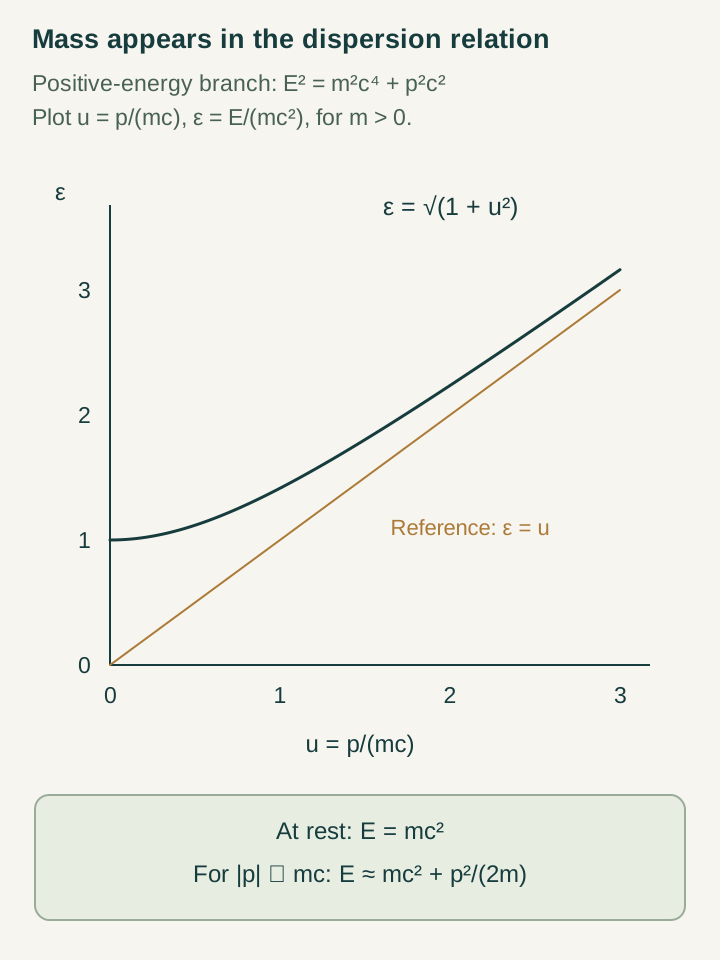
A common proper-time action S=−ε₀∫dτ yields low-speed inertial mass m=ε₀/c² and rest energy E₀=ε₀. It also produces E²=c²p²+m²c⁴. This gives an exact conditional route from one action coefficient to the energy–inertia relation.
DTT can connect ε₀ to a stable recurrent carrier if its phase has an independently calibrated energy law. The source must select the carrier's dispersion and use the same physical clock as the geometry. At finite resolution, an internal rest frequency and the curvature of the momentum band can give different mass assignments. Their agreement must be demonstrated within a stated regime.
Open the full-size diagram →
Fourth principle: a universal gravitational response
If every suitable test carrier couples to the same metric through −mc²∫dτ, varying its path gives a mass-independent geodesic equation. In a weak static field the Lagrangian becomes −mc²+mv²/2−mΦ, so the same coefficient governs inertia and passive gravitational response.
This common coupling is not forced merely by Lorentz symmetry or a shared cone. Species-dependent extra interactions can preserve a covariant description while violating universal free fall. The SMM/DTT task is to derive the coupling restriction from the actual source dynamics, including internal and binding energy, and then determine the separate law by which matter sources the geometry.
Worked consistency example across the first three principles
Use units with c=1 and a carrier whose invariant mass is one. At momentum p=3/4, the relativistic energy law gives E=5/4. Its group velocity is p/E=3/5 and the corresponding Lorentz factor is 5/4.
During Δt=5, the carrier travels Δx=3 and accumulates Δτ=4.
The interval is 25−9=16, agreeing with the clock reading squared. A common metric action also makes its phase proportional to this proper time. The example verifies compatibility of the supplied dictionary. It does not establish that one microscopic source uniquely selects the dictionary or the mass.
How to expose an unproved link
Keep a generated geometry fixed and alter one allowed material clock so that it responds to additional inner work. If both clock couplings satisfy all stated source assumptions, a universal time law has not yet been derived. Likewise, introducing a second field with a different kinetic coefficient tests whether the common-cone claim is actually enforced.
For gravitational response, change one species' potential coupling while leaving its free dispersion unchanged. If the model permits this, mass–energy equivalence alone does not establish the equivalence principle. Such countermodels are constructive: they identify the particular symmetry, interaction rule or completion constraint that a stronger source theory must supply.
What would count as a substantive advance
Choose one explicit autonomous source update with retained memory, local operations and a physical resource budget. Derive stable record geometry, at least two distinct clock carriers and two matter sectors. Define their measurements independently, then prove a relation that survives a family of refinements or perturbations without refitting separate coefficients.
A valuable next theorem might remove the freedom between protected and ungated clocks, enforce a shared principal propagation symbol, or derive a universal weak-field coupling. Any one would connect previously independent pieces of the four-principle programme. The eventual unified result should preserve those explicit dependencies, so that each recovered principle follows from the same source mechanism rather than being introduced anew at its interface.
Continue with the articles
- The Mass-Energy Equivalence
Use mass–energy equivalence as a focused case study in translating familiar physics into the language of temporal generation. State the physical relation before discussing proposed interpretations.
- A protected material clock
Describe the model that realizes resolution-only evolution through protected couplings. Explain which interaction restrictions protect the clock and how a controlled perturbation breaks that protection.
- Why one clock model does not prove universality
Use the ungated-clock countermodel to show that a realizable clock law need not be physically universal. Explain the extra selection principle required for all material clocks to agree.
- From record refinement to a joint clock–band relation
Introduce the conditional relation connecting geometry, clock response, and matter transport. Explain why the interfaces and coefficients must be independently calibrated.
- A finite-update cone
Introduce the bound relating horizontal displacement to temporal projection in the limiting-speed draft. Explain that the finite-update inequality is a stated geometric assumption.
- Why light must share the same cone
Examine the additional assumption that electromagnetic dynamics inherit the constructed null geometry. A limiting cone in one sector does not automatically establish universal propagation across all fields.
- When geometric symmetries become physical boosts
Compare automorphisms of a mathematical geometry with transformations realized by physical observers. Explain why frame richness is an additional requirement for identifying the two.
- What Lorentzian reconstruction leaves open
Summarize the boundary of the constraint-relative theorem. Recovering a causal geometry does not itself determine matter dynamics, the numerical limiting speed, or Einstein’s field equations.
- Four principles of quantum relativity: assumptions and consequences
Follow the four proposed principles through their mathematical dependencies. The guide connects complex temporal dynamics with SMM/DTT while identifying the extra assumptions needed to pass from an algebraic construction to a physical consequence.