


Transform the whole comparison
A frame change is a coordinated change of the time and distance assigned to an event. If only the clock label changed while the spatial comparison stayed fixed, the interval would generally fail to be preserved. The Lorentz transformation specifies the pair of changes together.
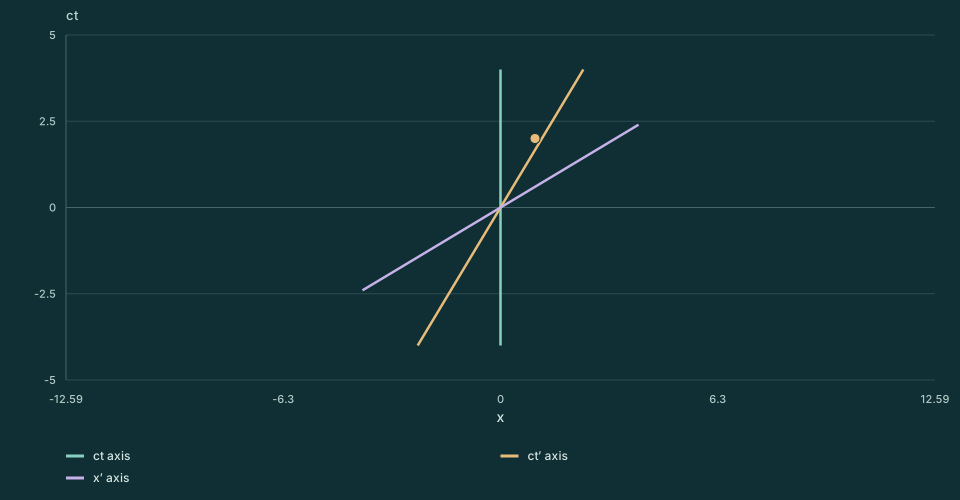
Let the primed frame move at positive velocity v relative to the unprimed frame. Their origins coincide at T=X=0. With T=ct, this choice fixes the signs in the formulas below: the primed origin follows X=βT in unprimed coordinates. The inverse transformation is obtained by changing β to −β.
The geometric language has a direct place in the books. Ordinary complex multiplication uses i²=−1 for circular phase, while split-complex multiplication uses j²=+1 for hyperbolic boosts. A common name does not make these the same operation. Their physical relationship requires a specified source-to-record construction. [B10] [B18]
Transform one event and a simultaneous pair
Change the event coordinates and the frame velocity. Compare the original and transformed values of s². Try a timelike event, a point on a light ray, and a spacelike separation. Each remains in its original causal class.
Interactive calculation
Play scans Frame speed β. Step advances it. No animation starts automatically.
Enable JavaScript for adjustable values. The static figure and worked calculation remain available.
As a worked check, take T=4, X=2, and β=1/2. Then γ=2/√3, so T′=2√3 and X′=0. Both frames obtain s²=12. The primed frame is the rest frame of the straight path connecting these events.
For a simultaneous pair, use ΔT=0 and ΔX=2 with the same boost. Their transformed separation is ΔT′=−2/√3 and ΔX′=4/√3. Their original interval −4 is unchanged. The negative time difference concerns distinct spacelike events, not the reversal of a clock along its own future-directed path.
Why the quadratic form is unchanged
Expanding the squares cancels the mixed terms. The remaining common factor is one because γ²(1−β²)=1. A null separation therefore remains null even though each of its coordinates changes.
Rapidity η is an additive parameter for boosts in one fixed direction. For z=T+jX with j²=+1, multiplication by exp(−jη) produces the two formulas. The invariant z z̄=T²−X² is indefinite: a nonzero null vector can have zero invariant, unlike a nonzero vector in a Euclidean norm.
The chosen sign convention makes the primed frame's own origin stationary: substituting X=βT gives X′=0 and T′=T/γ. This connects the coordinate transform to the moving-clock factor from the previous chapter.
Applying the inverse boost returns the original event. This is an additional check on the convention: using the same sign twice produces a second boost, not an inverse. Both the numerical coordinates and the units must be transformed consistently when comparing independent implementations.
A physical boost also transforms apparatus
A mathematical symmetry describes which transformations preserve a structure. Physical equivalence asks whether material clocks, rulers, preparations, and detectors can realize those transformations while giving matching predictions. A cone with the right algebra does not guarantee that all moving apparatus obeys it.
SMM/DTT therefore needs a common account of generated geometry and matter response. If source bookkeeping uses a particular ordering, public comparisons must either be independent of that convention or contain a quantitatively specified, testable preferred-frame effect. [R01] [R02]
The present lab uses standard special relativity as an exact target. It contains neither a new preferred-frame parameter nor a claimed experimental detection. The independent lecture notes give broader context, including three-dimensional transformations. [R20]
Continue to clock histories, or read the existing hyperbolic temporal geometry guide for a longer algebraic treatment.