
A supplied two-component spinor gives Pauli directional probabilities and a 4π return law. Its quaternionic rotation connection is exact, while particle identity, exchange statistics and physical interaction strengths require further construction.
What a spin measurement asks
A particle can possess orientation-related structure beyond its recorded position. A spin measurement compares that internal carrier with a chosen detector direction. The calculation requires a state, a transformation law and a measurement rule; a picture of a tiny rotating sphere does not provide them.
In SMM/DTT, persistent matter is proposed to retain organized generative structure through successive completions. A spinor is one precise candidate carrier for part of that structure. The question is why the source selects it and how completed directional tests access it, rather than whether several kinds of circular diagrams look similar.
Derive the half-angle rotation
For a unit vector n, the Pauli matrices satisfy (n·σ)²=I. Separating even and odd powers in the exponential gives:
=cos(θ/2)I−i sin(θ/2)n·σ.
A 2π rotation gives −I, while a 4π rotation gives I. The half-angle belongs to the supplied spin-one-half representation. The directional Pauli expectations transform as an ordinary three-vector. Thus the state carrier and its spatial readout have different transformation properties even though they describe the same directional experiment.
Worked example: a tilted detector
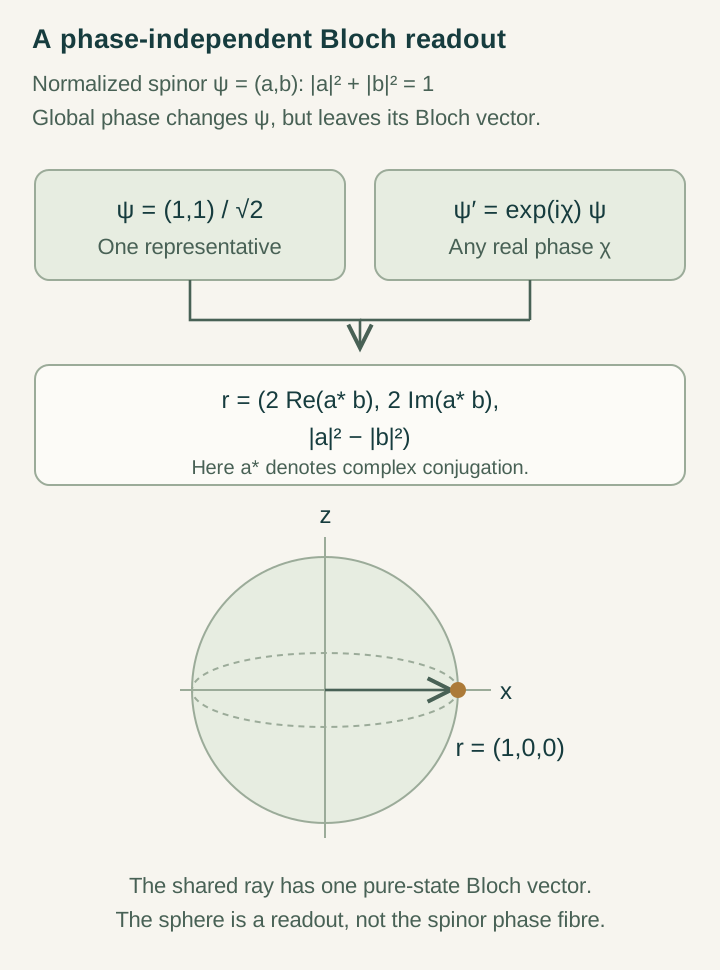
A normalized pure spinor ψ has Bloch vector r with components rₐ=ψ†σₐψ. Measuring spin along unit n gives outcomes ±ℏ/2 with probabilities (1±r·n)/2.
P(+ℏ/2)=9/10; P(−ℏ/2)=1/10.
The state is fully polarized, but it is not an eigenstate of the tilted detector. The probabilities follow from the supplied quantum test rule and carrier geometry. Deriving that carrier without deriving how its norm and projectors determine physical outcomes would leave part of the SMM/DTT measurement problem open.
When the 2π sign becomes observable
The isolated states ψ and −ψ have the same density matrix, so the global minus sign does not change their standalone measurement statistics. A coherent reference makes the difference observable: split the state into two paths and rotate the spin by 2π on only one path before recombination.
For balanced paths, the ideal plus-port probability after a rotation θ is [1+Re⟨ψ|U(n,θ)|ψ⟩]/2=[1+cos(θ/2)]/2 when other relative phases are matched. It is zero at 2π and returns to one at 4π. The measured object is a relative phase between histories, with coherence and reference preparation explicitly required.
The double cover in quaternionic language
Unit quaternions act on imaginary quaternions by v↦uvu⁻¹. The elements u and −u produce the same action because their signs cancel. This gives the two-to-one relation between the unit-quaternion group, equivalent to SU(2), and ordinary three-dimensional rotations.
The SMM/DTT quaternionic reconstruction supplies this carrier only under its associative positive-norm and incompatible-phase hypotheses. A complete scalar-insensitive readout then exposes three real directions. Those mathematical outputs connect phase and orientation, but they still require spatial comparisons, transport and physical calibration before they constitute a particle model in generated space.
Spin is not yet an exchange law
A rotation of one carrier and an exchange of two identical excitations are different operations. The 4π spinor law does not, by itself, derive antisymmetric many-particle amplitudes or Pauli exclusion. A many-particle construction must specify composition, locality, admissible states and the dynamical assumptions supporting the connection.
Likewise, the same abstract SU(2) group can describe spin rotations or an internal transformation acting on a different carrier. Equal group names do not identify the physical operations. A source theory must supply the map between a transformation and the apparatus that realizes or measures it.
A source-selected orientation carrier
The six nested inner roles could create and preserve the carrier, its phase comparison and the detector reference. Outer completion would expose the resulting orientation statistics. A successful construction should derive these operations from one update rather than placing a spinor into an independently programmed spatial model.
A manageable target is to produce the half-angle rotation law, the directional probability and the two-path sign test from the same retained state and instrument. It should then calculate stability under imperfect generation and clarify which memory must remain available for later interference. That would connect temporal organization to a specific set of spin observations.
Continue with the articles
- Why quaternions appear in the reconstruction
Introduce the positive norm, associativity, and incompatible-phase hypotheses that select a quaternionic carrier. Present the conclusion as conditional algebraic rigidity.
- The center-blind route to three dimensions
Explain how removing the scalar center from the quaternionic readout leaves three real directions. Clarify the operational meaning of a detector that cannot distinguish central changes.
- Hopf geometry from a spinor doublet
Introduce the relation between a two-component complex description and a sphere of readout directions. Explain the Hopf bundle’s role in the draft’s reconstruction.
- Relational transport and gauge freedom
Explain why independently unframed record fibers require a rule for comparison. Introduce gauge transport as a conditional reconstruction idea, distinct from the draft’s exact Hamiltonian results.
- Radiative inner-time loops: defining the proposal
Develop the skeleton draft’s temporal-loop language into a precise construction. Specify the states, interactions, and regulator before claiming a connection with radiative corrections.
- Real-commutant phase selection: a paper guide
Introduce the paper’s phase-selection question in real Hilbert representations. Prepare an accessible route from the commutant to compatible complex structures and their physical interpretation.