
A double-well potential demonstrates how exchanged stable branches arise. Their selection is distinct from explicit bias, finite-system averaging and the additional dynamics needed to produce irreversible completed records.
The law and its realized configuration
Let a real order parameter φ change sign under an interchange. A symmetric potential obeys V(−φ)=V(φ), but a configuration with φ≠0 is exchanged with another configuration. The law can preserve the transformation even though one selected state does not.
For SMM/DTT, this is a disciplined way to discuss the emergence of distinctions from a common framework. It requires a defined order parameter and an actual transformation of the source or its records. Calling one domain manifested and another hidden does not by itself establish an exchange symmetry or explain how a state chooses between its branches.
Worked example: exact stationary points
Choose V(φ)=λ(φ²−v²)² with λ>0 and v>0. Differentiation gives V′=4λφ(φ²−v²), so the stationary points are zero and ±v. Their curvatures are:
V″(±v)=8λv².
Thus zero is unstable in this potential and ±v are stable minima. For λ=1 and v=2 in dimensionless model units, the minima lie at ±2, their curvature is 32 and the barrier height V(0)−V(±2) is 16. The symmetry determines equal depths, while the chosen potential supplies the scale and the branch structure.
Adding a bias changes the symmetry statement
Add a term −hφ. For nonzero h, the potential no longer respects φ↦−φ. At the old positions ±v, the energy difference is exactly −2hv; the true minima also move. For sufficiently small h, expanding around either old minimum gives a leading displacement h/(8λv²).
This is explicit breaking because the governing expression now favors one sign. Selecting a branch of the exactly even potential is a different mechanism. A model should not insert a bias to choose the desired temporal orientation and then describe the choice as following from an unbiased symmetry.
A finite system can recover a symmetric description
A finite classical system subject to fluctuations may switch between wells. Over a short observation window it can appear to occupy one branch; over a much longer window an ensemble can have mean zero. In a finite quantum model with a unique symmetric ground state, that state also need not equal either localized classical minimum.
Long-lived branch selection therefore requires a declared regime, preparation and observation time. Thermodynamic limits or environmental stabilization can change the question, but they must be specified. DTT's completed records should identify which regime makes the selected distinction persistent and which perturbations can erase it.
What a temporal order parameter must measure
The temporal-interchange model uses an order parameter odd under exchanging two declared sectors. A difference of suitably defined gauge-covariant phase-gradient norms can have that property; their sum cannot distinguish which sector dominates. The comparison must be independent of arbitrary local phase conventions.
The two-sector construction should also be translated carefully into the later nested-role formulation. Six inner dependencies followed by outer completion are not six independently exchangeable clocks. A symmetry proved in a two-parameter model cannot simply be renamed a theorem about that hierarchy. One must exhibit the maps relating their states, operations and observable order parameters.
Orientation is not the same as irreversible dynamics
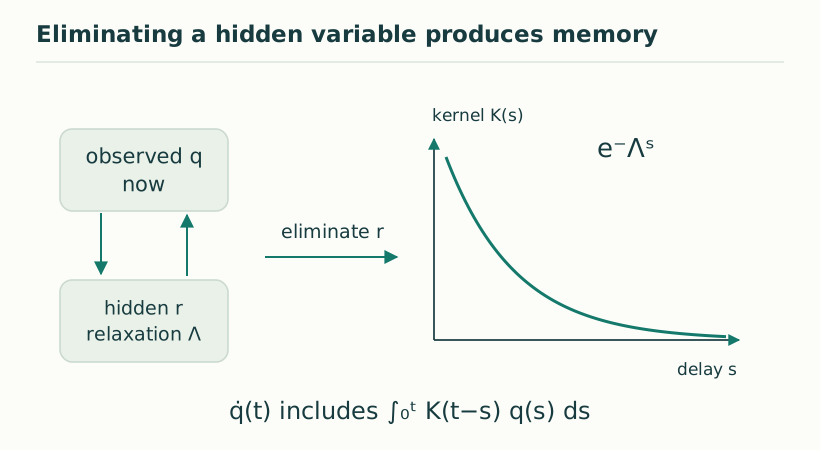
Choosing a sign of φ does not alone prove entropy growth. A reduced model can obtain memory by eliminating a hidden variable, but relaxation and monotonicity require additional dynamical conditions. For example, ẋ=−ax+by and ẏ=−γy+kx yield a kernel bk exp[−γ(t−s)] after y is eliminated.
With a>0 and γ>0, stability additionally requires aγ−bk>0. The kernel's existence alone does not enforce this inequality. A temporal branch can select an orientation while its dynamics remains reversible, unstable or oscillatory. The completed arrow requires its own retention and evolution law.
A source-level selection result
A useful SMM/DTT model should derive an observable order parameter, its symmetric dynamics and a mechanism that prepares stable branch records. It should calculate switching or leakage over a stated interval and show how the same source controls completion and subsequent memory.
The six inner roles may organize those dependencies, while outer completion publishes the selected record. The stronger result would connect branch selection to a measurable response or temporal asymmetry that cannot be adjusted independently. That would turn symmetry breaking into a concrete part of the source explanation without treating a chosen potential as a completed account of the cosmic arrow.
Continue with the articles
- Oneness and the Four Levels of Symmetry
A guide to the four levels of symmetry in the source account. Define each level and distinguish its conceptual role from a precisely specified physical symmetry group.
- Eliminating hidden variables creates memory
Explain how removing the hidden sector produces an exact Volterra equation in the dual-time gauge model. A memory term can emerge even when the larger dynamics are specified locally in time.
- The fast-response limit
Introduce the approximation in which hidden variables relax rapidly relative to observed motion. Explain how this yields a positive semidefinite effective realization metric.
- A monotone structural functional
Explain the conditions under which the projected structural functional becomes monotone. Distinguish this model-level result from a universal derivation of thermodynamic entropy production.
- Temporal interchange and degenerate vacua
Introduce the signed order parameter used to represent temporal interchange symmetry breaking. Explain why genuinely degenerate choices matter for the model’s symmetry argument.
- Temporal asymmetry: reading the published model
A reading guide to the published temporal-asymmetry model. Organize its geometrical assumptions, reduction mechanism, and interpretation before comparing it with later working drafts.
- Reading Volume III: Ultimate Symmetry
A focused topic map for the volume’s discussions of symmetry, complex time, and quantum gravity.