
Symmetry requires an explicit object, transformation and preserved structure. The same source can support a symmetric update, an asymmetric record and a smaller observable transformation group without contradiction.
Name the object, transformation and invariant
A circle, a dynamical equation and a detector record are different objects. Rotating a circle preserves its shape and distances. Transforming a solution of an equation may produce another solution. Transforming a particular state may leave it fixed or move it to a different allowed state. Each is a precise but different symmetry statement.
SMM's common-source proposal does not require every manifested state to look identical. Its constructive promise is that one source law can constrain many distinguishable outcomes. To express that promise mathematically, specify a state space, a transformation action and the relations that action must preserve. The adjective ultimate cannot replace those definitions.
Worked example: one geometry, different stabilizers
An unmarked circle admits every rotation about its centre. Mark one point and consider only rotations that preserve the marked pattern: the surviving rotation is the identity. Instead mark three equally spaced identical points. Rotations by zero, 120 and 240 degrees preserve the pattern.
One marked point: {identity}.
Three equal marks: C₃.
The subgroup preserving one configuration is its stabilizer. The ambient circular geometry did not disappear when the pattern acquired marks. This is a simple model of differentiated manifestation: the law or space can possess transformations that exchange allowed records, although an individual record preserves only some of them.
A symmetry of the update
Let U be one completed update and let T be a candidate transformation. If TU=UT, transforming before the update gives the same result as transforming afterward. The transformation carries whole trajectories into trajectories governed by the same rule.
For example, take a planar rotation U and any other rotation T about the same origin. Their angles add in either order, so they commute. An initial vector pointing right is generally moved by T; it is not itself rotation invariant. The dynamics nevertheless has that symmetry. A temporal reconstruction should keep the symmetry of its rule separate from the orientation of the state it happens to generate.
A conserved norm can retain an orientation choice
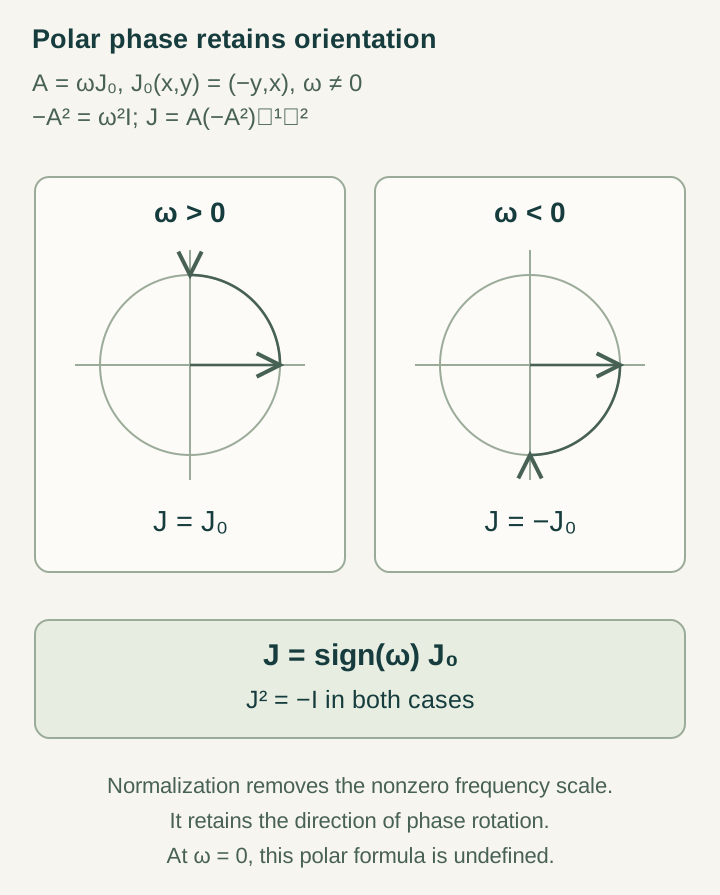
On a real plane let J₀(x,y)=(−y,x), and choose the generator A=ωJ₀. The flow exp(tA) preserves x²+y² for either sign of ω. The norm therefore does not distinguish clockwise from counterclockwise evolution, although the oriented dynamics does.
For ω≠0: J=A(−A²)−1/2=sign(ω)J₀.
The polar phase removes the nonzero frequency magnitude while retaining its orientation. At ω=0 the generator does not select a phase on that stationary sector. To write this flow as iℏ∂ₜψ=Hψ with A=JΩ, Ω=|ω|I and H=ℏΩ positive, identify i with −J. Choosing i=J instead reverses the Hamiltonian sign. This keeps phase orientation and energy convention consistent.
What completion allows an observer to distinguish
Let Π map source states to completed observable records. A source transformation can change an internal description while leaving every retained test unchanged. Such a transformation acts trivially on that observational quotient. Another transformation can carry one distinguishable record to another while preserving the observable laws.
DTT makes this distinction productive: inner generation may retain more information than any one outer display. The completion rule must state which transformations are invisible and which remain measurable. Invisibility to one immediate detector is insufficient if a permitted later operation reveals the difference. The full admitted test language determines the relevant equivalence.
When an invariant becomes a conserved observable
For a finite quantum model with Hamiltonian H, a time-independent observable Q is conserved when [H,Q]=0. Differentiating its expectation under unitary evolution gives an explicit check:
This calculation concerns a supplied Hamiltonian and measurement operator. Merely giving a source diagram a symmetric appearance does not produce Q or establish its conservation. A stronger SMM/DTT construction would obtain the update and the observable from the same retained structures, then show why their commutator vanishes or bound the error when the symmetry is approximate.
The next useful symmetry statement
The six inner roles are nested dependencies of generation, with outer completion as the seventh role. Their symmetry content must enter through explicit operations and retention rules. They should not be counted as independent symmetry generators simply because there are six names.
A productive next theorem would identify transformations of the source update, prove which descend to completed records and calculate an observable restriction: a forbidden coupling, a protected degeneracy or a conserved response. That would make source unity constrain manifestation without requiring every particular state to share every symmetry of its origin.
Continue with the articles
- Oneness and the Four Levels of Symmetry
A guide to the four levels of symmetry in the source account. Define each level and distinguish its conceptual role from a precisely specified physical symmetry group.
- One action, two temporal roles
Explain the draft’s same-cycle foundation: inner action is primitive, while outer record order comes from completed observable returns. Neither role automatically supplies a second readable laboratory clock.
- Test languages and observable quotients
Explore how richer tests alter the distinctions retained by a record model. Introduce the draft’s correspondence between test languages and observational congruences.
- Split-complex time and ordinary quantum phase
Explain why the split-complex pairing used for temporal roles differs from the ordinary complex scalar selected for phase. Avoid treating two algebraic uses of complex language as identical.
- Why a bare source does not imply spacetime
Introduce the obstruction showing that source order alone lacks enough structure to fix Lorentzian geometry. Use it to explain the role of the reconstruction’s additional assumptions.
- Real-commutant phase selection: a paper guide
Introduce the paper’s phase-selection question in real Hilbert representations. Prepare an accessible route from the commutant to compatible complex structures and their physical interpretation.
- Reading Volume III: Ultimate Symmetry
A focused topic map for the volume’s discussions of symmetry, complex time, and quantum gravity.