
Exchange symmetries, equivalent formulations and quantum complementarity make different claims. Explicit two-state and two-algebra examples clarify which relationships a source-and-completion construction can legitimately establish.
Three different uses of a paired description
An exchange symmetry transforms one allowed configuration into another while preserving a declared law. A dual formulation can encode the same physical predictions using different variables. Complementary measurements reveal different aspects of one state and may not admit a common sharp outcome.
These ideas can illuminate SMM/DTT, but none follows merely from calling time dual. The source model should say whether it proposes an invertible exchange, an equivalence of descriptions or two different functional roles. Inner generation and outer availability are already conceptually distinct. Establishing an additional mathematical relationship between them is a specific task.
Worked example: two complementary tests
For a two-component quantum carrier, let X and Z be the Pauli observables. A state polarized along positive Z gives the Z result +1 with certainty, while its X outcomes have equal probabilities. The same state supports both tests, but it does not assign definite values to both in the standard quantum description.
⟨X⟩=0, ΔX²=1.
Writing its Bloch vector as r gives ΔX²=1−rₓ² and ΔZ²=1−rz². Positivity requires |r|≤1, restricting the simultaneous expectations. The complementary descriptions concern measurement access to one carrier, rather than two independent material substances.
A transformation can exchange the tests
The Hadamard matrix H=(1/√2)[[1,1],[1,−1]] satisfies H²=I and exchanges the two observables: HZH=X and HXH=Z. Preparing Hψ before a Z measurement reproduces the corresponding X statistics of ψ.
This exact relation gives a concrete meaning to exchanging descriptions. It requires a specified carrier, a realizable operation and the chosen measurements. It does not identify X with inner time or Z with outer time. A DTT interpretation would need to derive an analogous operation from its source dynamics and explain which completed observations it exchanges.
Circular phase and hyperbolic pairing differ
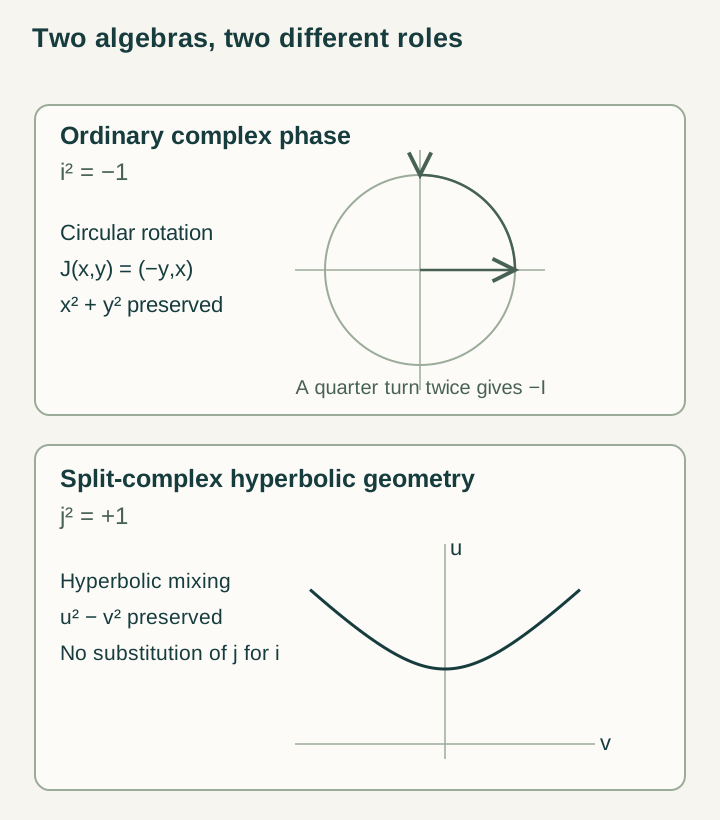
Ordinary complex phase uses i²=−1 and preserves a positive norm under multiplication by exp(iθ). Split-complex notation uses j²=+1 and preserves a difference of squares under exp(jη). Their elementary invariants are:
(a+jb)(a−jb)=a²−b².
Exchanging a and b in the second expression reverses its sign; it does not preserve the same quadratic form. An interchange may still be meaningful if the full model specifies how orientation or interpretation changes. The algebraic distinction must remain explicit when recurrent quantum phase and hyperbolic temporal geometry occur in one programme.
A many-to-one completion is not an invertible duality
Suppose four source histories become two completed records because pairs are observationally indistinguishable. The record map loses a distinction and cannot possess an inverse on those records alone. Calling the two descriptions dual does not recover the missing information.
A larger model may retain an environment or memory that makes the joint evolution reversible. Then the full state can preserve information while the public record does not. This is an important DTT possibility: generation and completion can belong to one process without being mutually invertible maps on the reduced observable state.
Wave-like combination and localized records
A balanced two-path comparison with relative phase φ gives plus-port probability P₊=(1+cosφ)/2. At φ=0 the probability is one, while at φ=π it is zero. Each registered outcome can remain localized even though the distribution depends on coherent combination before detection.
If the paths become correlated with perfectly distinguishable marker states, ignoring the marker removes the interference term. Partial marker overlap preserves partial contrast. The source-and-record connection is therefore a calculation about coherence, correlations and admitted tests, rather than a simple alternation between a wave substance and a particle substance.
A constructive temporal bridge
The six inner roles can organize the dependencies that create coherent alternatives, comparisons and stable records. The seventh completion role makes a selected result available. Their relationship should be expressed through maps and resource requirements, not by assigning one familiar quantum observable to each temporal word.
A useful next result would identify a common source invariant linking pre-completion coherence to completed statistics, then show how changing an allowed intervention transforms both descriptions. If the relation is invertible, prove the equivalence; if it discards information, identify what is retained elsewhere. That gives duality and complementarity distinct, useful roles within the SMM/DTT research programme.
Continue with the articles
- Temporal Entanglement and the Phenomena of Single Particle Interference
Introduce single-particle interference and the proposal of temporal relations between alternatives. Ask which observable interference features a temporal model must reproduce.
- Discreteness and Continuousness
Explore how discrete records and continuous mathematical evolution can coexist. Introduce the idea that different descriptions may concern different levels or observables rather than competing pictures of one variable.
- From one source to many observable records
Revisit oneness and multiplicity from the viewpoint of observation. Focus on how many distinguishable records could arise from a shared generative account and what preserves their differences.
- When two histories count as the same observation
Introduce completion and observational equivalence as distinct ways of identifying histories. Explain why the tests available to an observer determine which differences survive.
- Two phase actions and determinant closure
Compare the inherited polynomial phase with the selected coherent-output phase. Explain why determinant closure can produce a 137-fold condition only after the stated phase identifications.
- Split-complex time and ordinary quantum phase
Explain why the split-complex pairing used for temporal roles differs from the ordinary complex scalar selected for phase. Avoid treating two algebraic uses of complex language as identical.
- Temporal interchange and degenerate vacua
Introduce the signed order parameter used to represent temporal interchange symmetry breaking. Explain why genuinely degenerate choices matter for the model’s symmetry argument.
- Real-commutant phase selection: a paper guide
Introduce the paper’s phase-selection question in real Hilbert representations. Prepare an accessible route from the commutant to compatible complex structures and their physical interpretation.