
A transformation descends to completed records only when it preserves their equivalence classes. An eight-state cycle read modulo four demonstrates an observable quotient, its invisible kernel and the effect of enriching the test language.
Many records do not require many independent origins
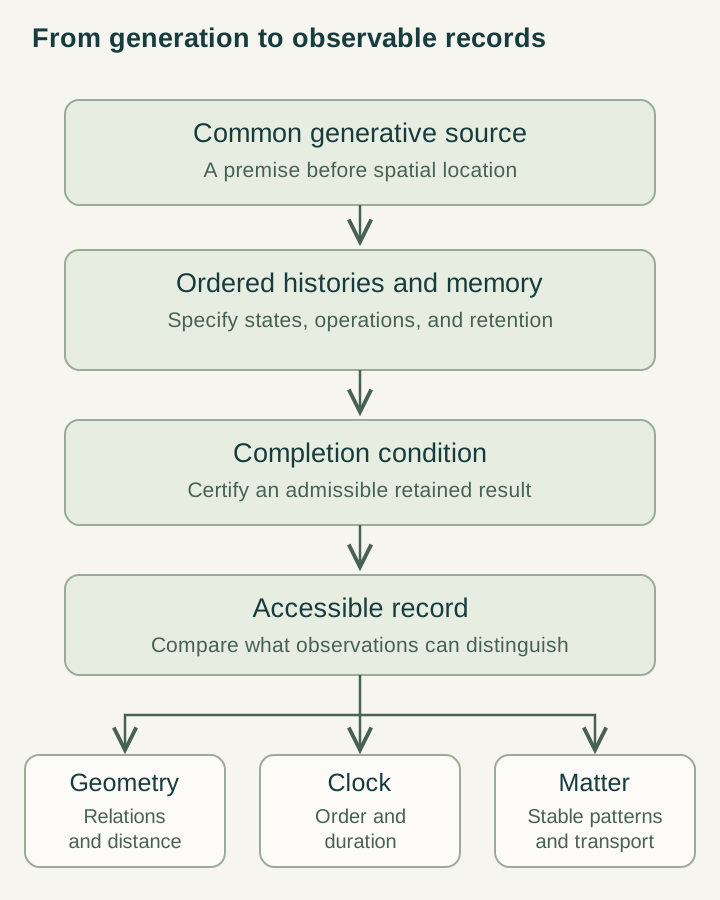
SMM treats observable multiplicity as the output of a common origin. A mathematical realization can contain many source states while still having one autonomous update and one rule of composition. The plurality belongs to possible histories and distinguishable records; the unity concerns the constrained process producing them.
To make manifestation more than a metaphor, state how a source history becomes readable. Let Π assign each admissible source state or history its completed record. This map may forget information, but the forgotten distinctions must be identified through actual tests. Merely assigning the same name to different states does not establish their observational equivalence.
The condition for a symmetry to survive completion
Let a group element g act on source states z. It induces an action on records by ḡ(Πz)=Π(gz) precisely when the result does not depend on which source representative z was chosen. The required condition is:
If every group transformation satisfies it, the completed quotient inherits a group action. Some elements may act as the identity on every record. Those elements form the kernel of the observable action. The quotient by that kernel captures the faithfully visible transformation structure, rather than the full internal symmetry written in the source description.
Worked example: eight source states and four records
Take source states n modulo eight, update U(n)=n+1 modulo eight and record map Π(n)=n modulo four. The source translation group is the eight-element cyclic group. Translation by k induces translation by k modulo four on the records.
ker(observable action)={0,4}; C₈/{0,4}≅C₄.
The completed observer cannot distinguish n from n+4 under this readout, and the one-step update respects that equivalence. Thus four observable states have an autonomous evolution even though the generating description has eight states. The calculation explains a particular compression of source distinctions; it does not establish a universal number of physical records.
A new test can reveal the hidden distinction
Add a detector that reports whether n lies in {0,1,2,3} or {4,5,6,7}. Together with the modulo-four readout, this one bit distinguishes all eight source states. Translation by four now changes an observable result, so it is no longer in the invisible kernel.
The source update has not changed. What changed is the declared interface between the source and its manifestations. This demonstrates why DTT completion must specify accessible preparations and future tests. If a later experiment can recover the supposedly forgotten bit, a predictive state that permanently deletes it is incomplete for that enlarged experiment language.
Nested generation and the public interface
The six inner roles of DTT are nested dependencies that can organize how a configuration is constructed. Outer completion is the seventh role, making the result available. Neither the number of roles nor the existence of a single controller determines the symmetry group of that result.
A concrete source model must give the update maps, their memory and the condition declaring completion. Only then can one calculate which internal transformations preserve the completion rule and which appear at the public interface. That calculation can distinguish genuine observable symmetry from changes in bookkeeping or from operations the observer cannot physically perform.
A record model can also display extra apparent symmetry
Discarding information can make a reduced description look more symmetric than the full dynamics. A detector reporting only the norm of a planar vector cannot distinguish its direction. Every rotation leaves that single reading unchanged, even if the underlying update selects one axis through unequal stiffnesses.
Such observational symmetry need not lift to a symmetry of the complete source law. To test the lift, add permitted directional preparations or follow-up measurements and check their outcomes. This provides a constructive distinction between genuine symmetry of physics and apparent symmetry caused by a restricted observation protocol.
What a manifestation theorem should prove
A useful next theorem would start from one source action and a derived completion instrument, identify its invariant equivalence relation and calculate the induced action on records. It should determine the invisible kernel, the surviving stabilizers and whether those transformations preserve future dynamics.
The physical interpretation can then ask how the same structure supports spatial orientation, conserved quantities or material clocks. This order gives SMM a precise relation between unity and multiplicity: the many records are constrained images of one process, and their symmetries follow from explicit maps rather than from an assumed resemblance to the source.
Continue with the articles
- The Oneness of Being
A source-based introduction to the Oneness of Being and its role in the broader cosmology. Clarify terminology before comparing metaphysical dependence with a model of shared physical origin.
- From one source to many observable records
Revisit oneness and multiplicity from the viewpoint of observation. Focus on how many distinguishable records could arise from a shared generative account and what preserves their differences.
- Oneness and the Four Levels of Symmetry
A guide to the four levels of symmetry in the source account. Define each level and distinguish its conceptual role from a precisely specified physical symmetry group.
- One action, two temporal roles
Explain the draft’s same-cycle foundation: inner action is primitive, while outer record order comes from completed observable returns. Neither role automatically supplies a second readable laboratory clock.
- When two histories count as the same observation
Introduce completion and observational equivalence as distinct ways of identifying histories. Explain why the tests available to an observer determine which differences survive.
- Test languages and observable quotients
Explore how richer tests alter the distinctions retained by a record model. Introduce the draft’s correspondence between test languages and observational congruences.
- Why a bare source does not imply spacetime
Introduce the obstruction showing that source order alone lacks enough structure to fix Lorentzian geometry. Use it to explain the role of the reconstruction’s additional assumptions.