An irreversible macroscopic trend can coexist with reversible microscopic laws and rare reversed fluctuations. This comparison derives the work inequality from a fluctuation identity, explains why retained records need thermodynamic accounting, and identifies what DTT must add to connect the direction of completion with a physical arrow of time.
Fluctuation theorems relate the probabilities of forward and appropriately reversed processes under stated assumptions about preparation and dynamics. They sharpen the second law without requiring every microscopic trajectory to increase entropy. A small system can show an atypical fluctuation while the ensemble still obeys a rigorous inequality.
DTT’s outer record order can explain why an observer has access to an accumulating past, but that ordering is not automatically a thermodynamic theorem. A record is implemented by physical degrees of freedom, and its preparation, stabilization and reset exchange energy and entropy with other systems. The comparison asks whether the source’s generative law supplies that accounting and relates it to the observable arrow. [2]
02The source and its two temporal roles
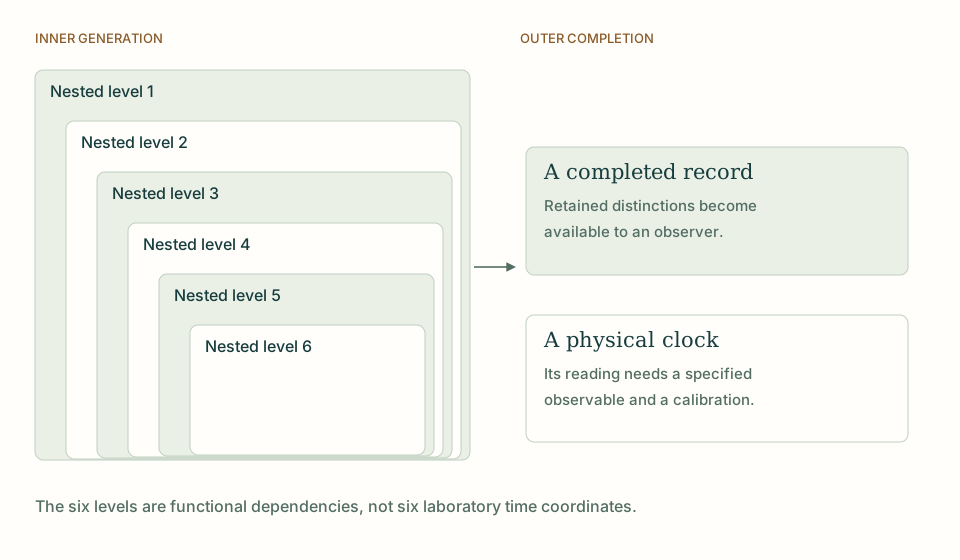
The Single Monad Model begins with one nonspatial generative source. The Duality of Time Theory distinguishes the source’s inner production from the outer order in which completed records become accessible. Its six inner levels are nested functional roles of one process: a higher role organizes lower-level work. The seventh is the completion or observation interface. They are neither six independent clocks nor six additional time coordinates.
This distinction supplies a useful research question: which features of an observed world can follow from the way a source produces, retains and releases information? A concrete answer needs a state space, an autonomous update, retained memory and a rule connecting completion to an accessible measurement. In the constructions discussed here, those mathematical ingredients are stated explicitly. A successful finite example establishes what its specified mechanism can do; further arguments connect it to physical particles, spacetime or universal laws. [1]
Six nested inner levels and outer completion. The nesting indicates functional dependence in the SMM/DTT proposal. Outer completion makes a retained result available; it does not turn the six levels into six independently measured clocks. View full size ↗
03Worked derivation of the mean work bound
For a suitable system initially in canonical equilibrium and driven by a prescribed protocol, Jarzynski’s equality is ⟨e^{−βW}⟩=e^{−βΔF}. Here β=1/(kBT), W is the work performed in a realization and ΔF is the equilibrium free-energy difference between the endpoint Hamiltonians. Convexity gives e^{−β⟨W⟩}≤⟨e^{−βW}⟩, and hence ⟨W⟩≥ΔF.
The mean excess work is nonnegative even though individual runs need not satisfy W≥ΔF. If W is Gaussian with mean μ and variance σ², its exponential moment gives μ−ΔF=βσ²/2. For an illustrative σ=kBT, the mean dissipated work is kBT/2. The equality links fluctuations and dissipation; it is not a law assigning the same energy cost to every computational or observational event. [2]
⟨e^{−βW}⟩=e^{−βΔF} ⇒ ⟨W⟩≥ΔF; Gaussian W gives μ−ΔF=βσ²/2
The stated preparation and protocol assumptions are essential. Work, free energy and kBT have energy units.
04Records do not create an exception to accounting
A memory that records an outcome can become correlated with the measured system. Its entropy alone may decrease or increase depending on preparation and conditioning, while the larger process includes apparatus, environment and any feedback controller. Ignoring rejected runs or the cost of resetting memory can make a process appear to evade a thermodynamic bound.
This is especially relevant to completion models with success flags. If only accepted records are analyzed, their conditional statistics can differ sharply from the statistics of the full operation. A DTT model should include the failures, the retained source state and the resources required to reuse the device. The physical meaning of an outer arrow then rests on a complete process rather than a monotonic counter that ignores the systems carrying it. [2][3][4]
05Microscopic symmetry and observable asymmetry
A reversible source update can still yield an effectively irreversible archive when the observer has restricted access to correlations or when low-entropy resources are consumed to stabilize records. This is a plausible realization of the DTT distinction between inner generation and outer observation. It does not imply fundamental time-reversal violation in the underlying equations.
Conversely, a model may introduce a genuinely irreversible microscopic law. That is a different proposal, with different constraints on probability, energy and possible recovery of coherence. The six nested functions do not decide between these options. A source-based theorem should state whether the arrow follows from dynamics, initial conditions, coarse-graining or an imposed rule for record retention. Those possibilities can coexist, but they should not be merged into one undefined notion of temporal asymmetry. [2][5]
06A result that would strengthen DTT
The constructive opportunity is a source model in which the same autonomous update generates a record, stabilizes it and determines a thermodynamic cost. A derived relation between error probability, retention time and dissipation would connect the two temporal roles to measurable quantities. It would remain conditional on the model’s physical resource assumptions, which is normal for a meaningful theorem.
The work identity is then a benchmark for the appropriate driven or extended process, not a proof of the metaphysical source itself. A monotone mathematical functional can be useful for showing convergence, but it becomes thermodynamic entropy only after its operational and energetic meaning is established. This distinction allows DTT to make a clear contribution to the arrow-of-time problem without mistaking a chosen order of computation for a universal law of irreversible physics. [2][4]
THE SAME QUESTION, DIFFERENT STARTING POINTS
The comparison at a glance
Question
SMM/DTT
Fluctuation theorems
Observable arrow
A growing archive needs a physical retention and resource model.
Fluctuation identities constrain probabilities of forward and reversed protocols.
Microscopic law
Reversible source dynamics can yield irreversible accessible records under stated conditions.
A macroscopic work inequality does not require every microscopic trajectory to be irreversible.
Quantitative target
DTT can seek a derived cost–accuracy–retention relation.
The Gaussian example links mean dissipated work to work variance.
KEEP THE CONNECTION
Key ideas
A growing archive needs a physical retention and resource model.
Reversible source dynamics can yield irreversible accessible records under stated conditions.
The source interpretation becomes additional physics when it constrains an independently measurable process.
Connects the comparison to the programme’s current statement of results and assumptions.
Sources and further reading
References support the comparator and the specific mathematical or interpretive claims indicated. SMM/DTT connections are developed in the analysis above.