


A sequence label does not calibrate a clock
The book distinguishes the order of completed updates from a physical duration. A repeatable process and a comparison with a standard are needed before an update count becomes a calibrated clock reading. It also requires an explicit relation between an inner evolution parameter and outer duration when a model uses both. [X01]
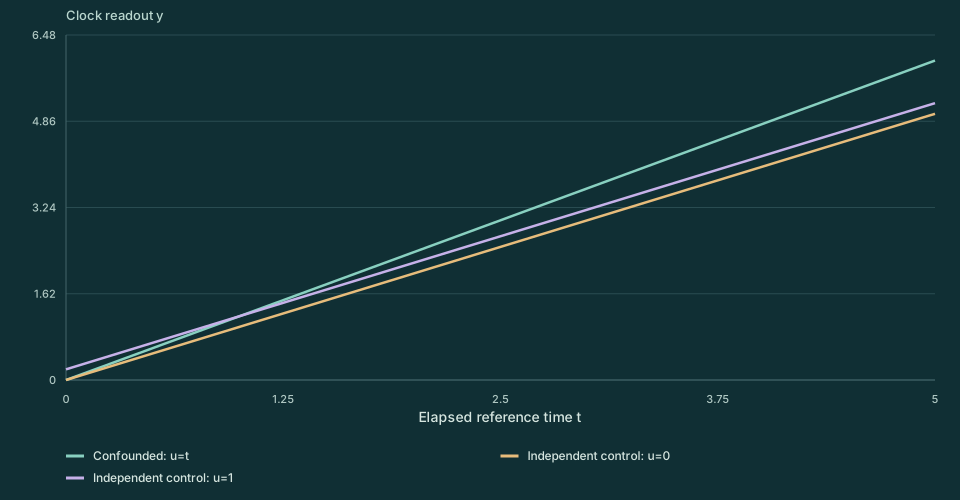
The laboratory represents a measured clock output by y=b+gt+κu. The offset b and gain g describe ordinary calibration. The variable t is the independently defined elapsed-time control. The variable u represents an independently commanded internal operation in this illustration. The coefficient κ is the extra response one would like to identify.
The word internal does not make u experimentally accessible. A concrete source model must identify which intervention changes it, what other quantities that intervention changes, and how the operation is counted. Here that interface is supplied so that the statistical ambiguity can be studied exactly. The displayed curves are predictions of a linear response model, not recordings from a new clock.
Compare confounded and independent controls
First consider a protocol in which u=t in the chosen units. Changing κ then changes the observed slope in exactly the same way as changing g. A precise line fit cannot tell which coefficient caused the change. The observable slope is g+κ.
Interactive calculation
Change the inputs to compare the model outputs.
Enable JavaScript for adjustable values. The static figure and worked calculation remain available.
The other curves hold u at zero or one while scanning t. Their fixed-time difference is κ, so b and gt cancel. For example, at t=2 with b=0.1, g=1, and κ=0.2, the choices u=0 and u=1 give outputs 2.1 and 2.3. Their difference 0.2 identifies κ in this ideal model.
Inspect the independent directions in the design
Fitting b, g, and κ requires three independent columns in the design matrix. If uᵢ=atᵢ+c for every run, the third column is a linear combination of the first two. The outputs depend only on b+cκ and g+aκ. No reduction of measurement noise can recover three coefficients from those two combinations alone.
With an intercept included, inspect the centred controls tᵢ−t̄ and uᵢ−ū. A correlation near ±1 means near-confounding and large uncertainty in separating the two responses. Exact proportionality gives a zero singular value; almost proportional controls give a small one. The distinction between formal identifiability and useful precision therefore matters.
A balanced pair with u₂=−u₁ also makes the pair average equal b+gt. Repeating such pairs at different t values can identify g and b independently of κ, provided the paired runs share the same calibration and the linear model remains valid.
For independent equal-variance output noise, least-squares coefficient covariance is σ²(XᵀX)⁻¹ when X has full rank. If errors are correlated, the covariance matrix belongs in the fit. Shared environmental drift cannot be treated as independent merely because the outputs were logged in different rows. Measurement-model guidance treats these sensitivities and covariances explicitly. [X09]
Design a test of a physical clock law
A practical protocol would choose an operation that can vary without silently changing reference duration, temperature, field exposure, or readout efficiency. Matched dummy pulses, reversed controls, and repeated reference readings can reveal such dependencies. Their role is to constrain alternative explanations, not to guarantee that every systematic effect has disappeared.
A null κ constrains only the tested response, preparation family, and resolution. It does not prove that every material clock is independent of all inner operations. Conversely, a nonzero κ needs comparison with ordinary interactions before being interpreted as a departure from clock universality.
SMM/DTT gains predictive content when a source law fixes which operations affect a clock and with what dependence, across multiple material sectors. The same calibrated dictionary must then be used in matter propagation and relativistic comparisons. [X02] [B16]
Continue to retry memory for another ambiguity: repeated attempts can disagree with an independent-trial law even when their first-attempt success probabilities agree.