


A controlled change can reveal a shared dependence
Two isotopes can share the same electronic charge while differing in nuclear mass and structure. Their spectral comparison can reduce some common calibration dependence, but it also introduces nuclear information. A useful test specifies which quantities are shared, which are independently measured, and which corrections are retained.
The laboratory considers two point nuclei with the same charge and the same supplied α. The only change is the nuclear mass M. It retains the leading two-body reduced mass and otherwise uses the nonrelativistic Coulomb model. Its masses are illustrative inputs, not authoritative proton or deuteron values.
The existing SMONAD isotope guide develops this distinction between a common electronic law and additional nuclear inputs. A source programme should use the same electronic operator and normalization across the family, rather than introduce a separate unexplained energy conversion for every isotope. [X11] [X03]
Change one mass ratio and predict the spectral scaling
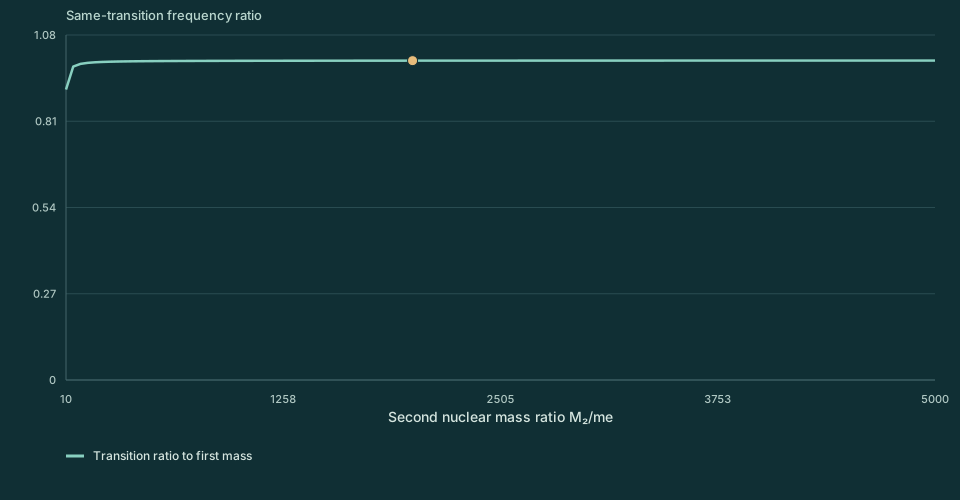
Set the dimensionless nuclear-to-electron mass ratios R₁ and R₂. The laboratory calculates each reduced mass in electron-mass units and their ratio q. The same ideal Coulomb transition has frequency ratio ν₂/ν₁=q because its other factors are shared.
Interactive calculation
Change the inputs to compare the model outputs.
Enable JavaScript for adjustable values. The static figure and worked calculation remain available.
For the illustrative choices R₁=1800 and R₂=3600, q=3602/3601≈1.00027770064. The heavier-nucleus atom has the larger reduced mass and a transition frequency higher by about 277.7 parts per million in this leading model. This numerical exercise is not a precision hydrogen–deuterium isotope shift.
Reduce the two-body motion before comparing lines
The relative coordinate has kinetic energy p²/(2μ). The centre-of-mass motion separates in the ideal isolated two-body Hamiltonian. Substituting μ into the Coulomb energy scale gives B=μc²α²/2, while the dimensionless level pattern remains Eₙ/B=−1/n².
The characteristic radius scales oppositely: a₂/a₁=1/q. At fixed α, the relative RMS speed for a given principal level is independent of μ, while the electron speed about the centre of mass carries the additional factor μ/mₑ. These are distinct observables of the same two-body model.
For large R, μ/mₑ=1−1/R+O(R⁻²). The leading fractional transition difference is consequently about 1/R₁−1/R₂ when both nuclei are heavy. The exact ratio in the laboratory avoids using this approximation outside its useful range.
Differentiating gives ∂lnq/∂R₂=1/[R₂(1+R₂)] and ∂lnq/∂R₁=−1/[R₁(1+R₁)]. Independent mass uncertainties therefore propagate into the predicted ratio; correlated mass determinations require their covariance too. A ratio can cancel a common scale without cancelling every input uncertainty.
For the default illustrative mass ratios R₁=1000 and R₂=2000, the exact transition ratio is 2002/2001 and the leading shift is about 499.75 parts per million. Swapping the two isotopes replaces q by 1/q. The fractional shifts therefore do not simply negate at finite separation: q−1 and 1/q−1 have different magnitudes. Keeping the ratio convention explicit avoids a spurious discrepancy.
Separate a baseline shift from a new residual
Real isotope spectroscopy also involves recoil beyond the leading reduced-mass substitution, finite nuclear size, nuclear polarizability, spin structure, radiative corrections, and apparatus effects. The appropriate baseline depends on the selected states and transitions. Adding measured isotope names to this simple slider model would not make it a precision prediction.
A candidate new contribution must be compared with conventional effects that have the same state and isotope dependence. If two mechanisms shift every selected line in proportional ways, the comparison constrains their sum. Additional transitions help only when their calculated sensitivity directions differ.
Freeze the shared electronic parameters and independent nuclear inputs before examining reserved transitions. A nuclear radius inferred using those same reserved lines cannot then be treated as an entirely independent input to their prediction. The dependency record is as important as the smallness of a residual. [X02] [X05]
For a common-source theory, success would mean several linked isotope and state dependences following from one restricted prescription. The leading reduced-mass relation is a necessary conventional baseline, not a distinctive SMM/DTT signature. Continue to reserved predictions, then inspect independent sensitivity directions to make that comparison quantitative.