



5.3.3.3 Method II (Generating Mass in the Inner Time)
We can also arrive to the mass-energy equivalence relation directly from the starting equation 5.7 in an alternative manner if we consider a sudden decoupling, or disentanglement, of the geometrical points that couple together in order to constitute the physical particle that appears in the outer level of time with inertial mass moving at an apparent (imaginary) velocity
 , so when these geometrical points are disentangled to remain at their real speed (of light), the mass
 converts back into energy
 while the apparent velocity does not change, because this process is happening in the inward level of time which appears outwardly as instantaneous. Thus, if we put
 in equation 5.7 and integrate over mass from
 to zero (where
 ), or vice versa, we get:
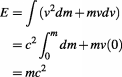 (5.10)
Unlike the classical case in equation 5.8 where the change in speed occurs in the normal outward level of time, these simple derivations (in equations 5.9 and 5.10) would not have been possible without considering the inner levels of time, which appears outwardly as instantaneous.