



5.3.3.7 Method III (from the Definition of Momentum)
The total relativistic energy in equation 5.11 can also be obtained by integrating the starting equation 5.6 over the inner and outer time together, since in the inner time the rest energy , or mass
 , is generated at the speed of light
 as a result of the instantaneous coupling between the geometrical points which constitutes the particle of mass
 (thus
(thus and
and in the inner time), and in the outer time the kinetic energy
 is generated as this mass
 moves gradually so its apparent velocity changes by
 , which corresponds to increasing the effective mass from
 to
to , thus we can integrate:
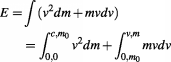 (5.13)
Thus we get the same equation 5.11 or 5.12:
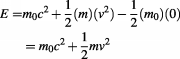 (5.14)
This equation can also be given in the general form that relates the relativistic energy and momentum (see Appendix 3.3.8 for how to convert between these two equations):
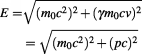 (5.15)
This last equation, that is equivalent to equation 5.14, will be also derived directly from the Duality of Time postulate in section 3.4, while in Appendix 3.3.8 we show how to derive it classically from equation 5.12 starting from the effective mass relation: .
.
Again, however, a fundamental derivation of this relativistic energy-momentum equation 5.15 is also not possible without the Duality of Time postulate. All the current derivations in the literature rely on the effective mass relation: , which is equivalent to the same relation we are trying to derive (see above and also Appendix 3.3.8), while finding this equation from the four-momentum expression, or space-time symmetry, relies on induction rather than rigorous mathematical formulation.