



7.2 The Hidden Symmetry
We explained in chapter III that super-symmetry was utilized in order to solve the Hierarchy Problem of the Standard Model of Elementary Particles, and it is also a key ingredient for the consistency of Strings Theory. Super-symmetry supposes that for every particle, including the anti-particles, there is a super-partner with the same mass but different statistics, so that any loop in a radiative correction is canceled by the loop corresponding to its super-partner, rendering the theory more finite in the ultra-violate range. However, no such super partners have been ever observed, so if super-symmetry existed it should have been broken severely.
Based on the conclusions from chapter VI, that the flat space corresponds to pure eternal light filling the void, while our physical world is only
 space that is evolving in the imaginary time, and recalling from the previous conclusions in chapter V that each two opposite arrows of time constitute one dimension of space, we can then conclude that the
 physical world is created by “splitting” one dimension of the
 space into two time directions. The result of this splitting is two parallel worlds that evolve on two opposite time directions, which explains why we do not detect our anti-world by any normal physical sensors. This anti-world is actually the same psychical world that we mentioned in chapter VI and it has exactly the same atomic structure as the physical world. The mere acts of perceptions, such as hearing or seeing, are direct physical interaction between the particles of these two complementary worlds.
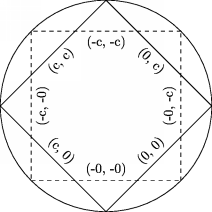
Figure 7.1: The Splitting of the heavens and earth into two parallel worlds that exist in two opposite arrows of time. This actually means mixing the symmetrical dimensions of the perfectly symmetrical and spherical three-dimensional space, into two two-dimensional space-time with conjugate time directions, which formed the physical and psychical words, each of which is but they are on two orthogonal dimensions. Each of these two symmetrical worlds is based on the four classical elements of Nature: earth, water, air and fire, which are the four space-time Quantum fields described by:
 ,
, ,
, and
and , respectively.
According to this splitting which will be discussed further in section 2.3, the physical world and its anti-world are described as and
and respectively, and they form together the
 flat space, the space of constant entities described in chapter VI. This absolute flat Euclidean space is a fully spherically symmetrical space, without time, as described by Equation 6.3 and Figure 6.5 in chapter VI. Therefore, there is no need to introduce any new super-symmetry to the Standard Model or Strings Theory, because the anti-particles are already there; the same present symmetry is enough to support this idea of parallel Universes which also explains the asymmetry of matter and antimatter, since they originally exist on different axis of time. In other words: the super-symmetry we are searching for is the present symmetry itself, and the rare antiparticles that we observe in our Universe are some casual visitors from the parallel world. This could in principle solve many major problems in physics, that we listed some of them at the end of chapter III, including the hierarchy and quantum gravity problems, but this requires a separate more detailed technical analysis.
Nevertheless, starting from the trinitarian world equation that we described in chapter VI (section 8): , which described the equation of a perfect sphere in the
 Euclidean space
 ; we can “split” one spatial dimension, such as
 , into two opposite arrows of time
 , by noting that the resulting time directions are split-imaginary, or hyperbolic, numbers. Therefore, the two opposite time directions are two conjugate complex numbers, thus:
 , or in the polar coordinates, each point in the resulting positive space-time can be expressed in the form:
 , while each point in the resulting positive space-time can be expressed in the form:
 , which become real when multiplied together:
 .
.