



7.3.4 Fractals and Divergent Series
For the same reasons of deceptive multiplicity that cause the illusion of motion, the human mind is accustomed to viewing physical objects enclosed in three spatial dimensions. Although we can feel one and two abstract dimensions, we always conceive all objects, including surfaces and lines, as three-dimensional, because an abstract two-dimensional surface has no thickness, and this does not exist in the physical world that we normally conceive, neither does the abstract one-dimensional line which has not no thickness or breadth. Actually, our feeling of dimensions is all deceptive, because they necessarily imply multiplicity which requires time iterations to be conceived in the mind, as we have already explained in chapter VI.
Fractal dimensions are used in mathematics to describe and simulate natural objects and phenomena, and they are normally regarded as artificial tools used only in abstract mathematics. However, one simple way to view these fractal dimensions is to consider every small rotation, between and
and for example, as a fraction of the whole dimension
 plane. So in reality fractals are as real as the whole integer dimensions, although both are some kind of intellectual reasoning to classify things in space and time.
Fractal dimensions are usually identified with patterns that repeat at various scales, so they measure their degree of roughness when things are not completely smooth, unlike whole dimensions which are smooth on all scales, because they are considered as real abstract frames that exist in absolute background. That is why fractals are also known as expanding or evolving symmetry, while normal dimensions are perfectly symmetrical.
Therefore, a real three-dimensional space is an abstract construct that is symmetrical in all directions, while actual physical objects, since they have various imperfect symmetrical features, are less than three-dimensional, but they are also more than two-dimensional, because they are not completely flat. Likewise, a flat painting, for example, is more than one-dimensional curves, but it is less than two-dimensional, because a two-dimensional plane is completely flat and symmetrical or isotropic, i.e. it has no distinguishing features.
Example of fractals include the Menger sponge, the Mandelbrot set, and Koch snowflakes as shown in Figure 7.10. Because these patterns repeat at various scales, the length of their circumference is infinite. In fact, as we have seen above, this is also true for all kinds of shapes, even a simple square or circle, which are normally viewed in whole integer dimensions, because physical objects, no matter how they look outwardly smooth, are composed of discrete particles and even granular space geometry. So the whole concept of length or dimensions involves some approximation, which is usually performed through integration, or squaring, as we described above.
Although we do not realize it, but what we actually mean when we say that an object is three-dimensional is that it is enclosed in three dimensions, which actually means that its dimensions are less than three. Even a perfect symmetrical sphere is still less than three dimensional as far as it is finite, so it is in fractal dimensions.
In reality, therefore, although the physical spatial dimensions are altogether not real, they are best treated as fractals rather than whole integers, as there had been some attempts to formulate various models based on fractal cosmology, also supported by various experimental data from te distribution of nearby galaxies Baryshev and Teerikorpi (2002).
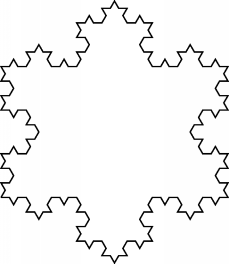
Figure 7.10: In Koch Snowflake fractal, or Koch star, the progression for the area of the snowflake converges to times the area of the original triangle, while the progression for the snowflake’s perimeter diverges to infinity. Consequently, the snowflake has a finite area bounded by an infinitely long line.
One of the main characteristics of fractals is that they have finite area but infinite perimeter. In a more general manner, the measure of any object with dimensions is
 in dimensions larger than
 and
and in dimensions smaller than
 . For example, as in Figure 7.10, the Koch Snowflake curve has dimension between one and two, so its measure in one-dimension is infinite, , which is its perimeter length, but its area, as a measure of two-dimensions is zero, but along the line and not as the filled two-dimensional shape.
Therefore, in studying fractals, geometric series are used to measure the perimeter, area, or volume of the self-similar figures. For example, the area inside the Koch snowflake can be described as the union of infinitely many equilateral triangles, whose sides are exactly the size of their parent triangle, and therefore it has exactly
 the area, and so on for the child triangles, so the total area of the snowflake is:
 , which can be shown to converge to
 , so the total area of the snowflake is
 the area of its original triangle, because the general formula for a geometric series is:
 , interpreted as Taylor’s power series which converge when
 .
.
The convergence of geometric series means that the sum involving an infinite number of summands can be finite, and this is usually applied to resolve many of Zeno’s paradoxes, but this solution is not complete because it still requires infinite number of steps, as we explained in chapter II.
Divergent series are infinite sequence of the partial sums that do not have a finite limit. One of the most important divergent series, which is encountered in various physics theories, is the infinite series whose terms are the natural numbers and its
 partial sum is the triangular number:
 , which increases without bound as
 goes to infinity.
This series is typically manipulated to converge to by many peculiar summation methods, such as zeta function regularization and Ramanujan summation, and it various applications in Complex Analysis, Quantum Field Theory, and Strings Theory.